Outlining: The Second Level

So in my last post, I discussed the importance of outlining. Again, if you can write novels that you’re happy with without outlining, then you don’t need to read this post. But I couldn’t.

So, using the outlining I described, I wrote about three and a half novels, including the horrible first trunk novel. But I still struggled with each individual chapter, After all, a chapter of a novel is about as much work to write (although it is a whole different kind of work) as a short story. And I kept finding that once I got down to chapter-level writing, I hadn’t outlined as much as I thought I had. I had to make decisions about how the characters made decisions on the fly, and sometimes these would have far-reaching implications for the whole flow of the novel. I’d have to stop the flow of my prose to re-plot (or sometimes, plot for the first time) crucial events. For example, in my last completed novel, I had a scene where I needed characters on an airship to chase down characters on an ocean vessel. The problem was, while you certainly can (and people have) docked airships to ocean ships, you can’t do it without an actual platform for that purpose. So I had to go back and write a backstory that explained why the ocean ship on question had that capability in the first place.

What I figured out, halfway through, was this: you can outline chapters as easily as you can outline full novels, and it’s helpful for the same reason that outlining the whole novel is. You can scribble down dialogue flows, rearrange the order in which things happen, and see quickly if you’re doing anything that violates later continuity, without having had to pound out pages of text. Then, when you ARE in the flow of producing text, you don’t have to stop and solve problems.

Using this technique, the last half of my novel just flowed like water. And for the first time, I discovered that writing a novel did not feel like a terrible, endless slog. That doesn’t mean that there were zero problems, and frankly, the fact that I’d finished three previous novels doubtless had its effect as well. But it was like turning out of a headwind that’s always been there, and I wished I’d figured out this bi-level outlining technique sooner. And so I offer this advice for what it’s worth, because I wish I hadn’t had to figure it out for myself.

I have wondered why novelists don’t talk about this more. I don’t see them doing it, anyway. There are several possibilities. First and most likely, other novelists know just how individual novel-writing is, and they don’t think their experience will be helpful. Secondly, they may have internalized it to the point they don’t think about it anymore. Finally, I may just not have been reading in the right places. But I hope my readers will find my effort here helpful.

Outlining

So, why outlining? First, a caveat:

One of the most valuable pieces of writing I ever got was at Clarion, from my two instructors, Karen Joy Fowler and Tim Powers. They essentially said that the only right way to write a novel was the one that produced a novel. That didn’t seem very helpful at the time, when I had written only one really bad novel.
But the point I eventually figured out, was that they were saying that novels could be written using any method if you stuck to it. Karen was a pantser. She started writing and just kept going until she had a novel. Tim was a compulsive researcher and outliner.

But what I really wanted, back then, was for someone to tell me what had worked for them so I could try it out and see if it worked for me.

See, the problem I kept having while I was writing even short stories was that I would get so many ideas of where to go next that I would not be able to hold them all in my head, and this led to frustration and time-wasting while I desperately tried to remember what I was supposed to be writing now, as opposed to ten pages from now. So here were the benefits of outlining for me:

Remembering The Ideas I Had: I can’t tell you how many times I would get to the end of a scene I was intensely into and then just… stop. Where was I going with this? I had a plan. I had the plan just an hour ago. But what was it? It was gone. It was so good and I was sure I would never forget it. But I did.
If you’re not the kind of person this ever happens to, then I’m sure this is laughable. That’s okay: you have one less reason to become an outliner. But I don’t believe I’m the only one it happens to.
The outline ensures that I can simply look at it and say, “Ah, yes, that’s where I was going.”

Revealing Contradictory Ideas: In the heat of evolving the story, it’s very easy to come up with MANY cool ways to tell it.  Oooh! What if the aliens are super-fast carnivores and our heroine has to lay a trap for one. Oooh! What if the aliens are natural hunters and she leads them on a long chase around the island, and..?
See, there’s nothing wrong with those ideas. Either will work. But they can’t BOTH work. A fast carnivore will, by definition, run our heroine down very quickly.
The outline doesn’t stop me from having to make these choices, obviously. But it does reveal the contradictions quickly, and avoid having to throw out pages of prose because I wrote myself into a corner.

Being Able To See The Pattern-Flow Of The Whole Story: This is probably the biggest benefit for me, though it’s kind of a combination of the first two advantages. Scribbling out and refining an outline is great for getting the whole thing down and being able to quickly spot where you have contradictions, or long stretches of nothing, or events that don’t logically follow from one another. It allows you to fix those things before you’ve written, say, 50 pages of prose, 40 of which are now crap.

So, if you’ve found this useful, you now have an outline.

Now you’re ready to outline!

I’ll explain what I mean by that tomorrow.

How To Start Your Novel

Or, more truthfully, how to start MY novel, but who knows, it may work for you.

I actually had trouble starting this novel. It took me awhile to figure out why. And the answer is that even though it’s my fifth novel, I’ve never just started a novel, with the intent to write a novel, absolutely cold with a clear idea of where I wanted to go with it.

Of my previous four novels, The Morning Of The Dragon (a college trunk book that will never see the light of day) started as a short story, as did Across The Endless Ocean. That one actually started life as three short stories, two of which I sold before I figured out where it was going as a novel.

A Calling In Darkness started out as a novel, but I pantsed the first three or four chapters before I had a clue as to where it would end up. Beneath the Verdant Tide was the closest I came to starting a novel with an intentional end, but the vision of that end was (and the ultimate end still is) vague enough that it hasn’t risen to the level of outline.

This novel, which has the inauspicious working title of Project Moon 2099, was commissioned by the publisher, leaving me in the position of actually outlining the whole thing before really starting to write. That gave me a short-term goal, which was useful, but made starting the thing paradoxically harder because this time I could see every bloody mile of the path I was about to start on. And that was surprisingly difficult to start.

Now, why start with an outline in the first place? That, my friends, is a subject for another post.


Patreon Report: What I Am Learning

Well, due to a few highly dedicated fans, I’m going to call my Patreon launch a success in the past 24 hours. Yes, right now I have only 3 patrons, but there are much better-known authors than me who have only about a dozen after months, so I’m not worried. So what HAVE I learned in this process that I could pass along to anyone else?

Have Your Rewards In Place: I was not expecting to have to fulfill high-level rewards so soon (if ever) and was really taken aback by having to fulfill them immediately. Be ready for success.

Editing Is Hard: I placed a Kindle self-pubbed novelette in place for my rewards. Despite having read it over several times, and having had other people read it, I still noticed errors within 24 hours and had to reupload the book.

Book Covers Are Not As Hard As I Thought: It took surprisingly little time to find an appropriate book cover app for no money. I recommend Calibre for converting to Kindle, Canva for cover creation and Pixabay for images, but there may be better resources (if you’re aware of one, let me know!)

Of course, there are a number of things I still wish I knew. Productive advertising remains very difficult. Facebook’s advertising has not seemed profitable to me in the past. Word-of-mouth (or perhaps word-of-share) is the best, but hard to generate even from good fans. I will continue posting about this as I learn more.

Patreon Launch!! With Bonus Novelette!!

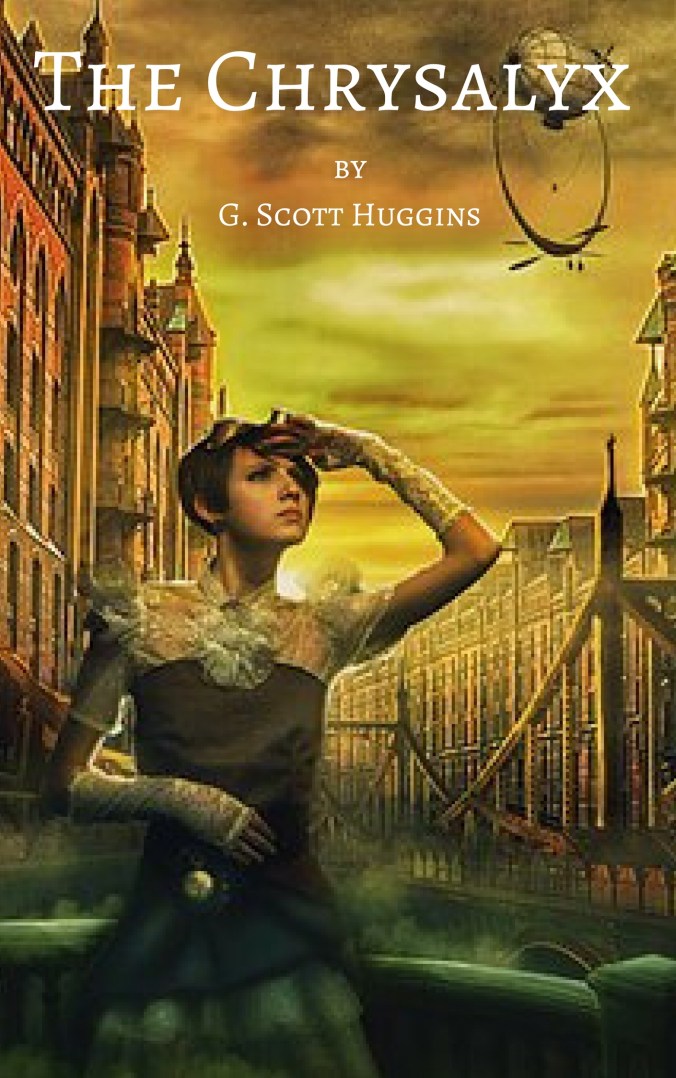
This is one of the major reasons for the hiatus of last week. I was preparing to launch my latest venue. If you are up for supporting me for $1 on Patreon, you get first crack at my steampunk alternate-history novelette, “The Chrysalyx” in .mobi (Kindle) format. This novelette will revert to the Secret Story Vault ($30 tier) in April.

In a world where dreams can shape flesh, and the British and German Empires maintain an uneasy peace with the Confederate States, Special Agent Aemelia Stapledon and Jupiter Breckenridge of the President’s Guard must discover the limits of the transhuman and their own capabilities if they are to stop a plot to re-image humanity into its darkest nightmares. Their hunt will lead them to the highest levels of power, and to the unfathomed depths of The Chrysalyx.

Taking The Week Off

Dear Followers and Readers:

I wanted to let you know that I am taking the week off from blogging. The reasons for this are actually very good, personally. This week, I landed a new day job which I am very excited about. I am also working on a new novel, which I am writing under contract. And on the 1st of March, I will be taking part in a reading in Chicago. I would be honored to see anyone there.

I will be back to the blog next week. Things are going very well, but it also means things are going much busier.

To fill the void in your life, why not buy some of my wonderful fiction from Amazon.com

From Somewhere In Orbit.


Words: Stranger Things 2, Episode 9 Microblog (Much Spoilers, Etc.)

The Good: An awesome ending to an awesome show. I’m really not sure what to say about it that wasn’t great. In some ways, it reminded me of The Lord Of The Rings, with El and Hopper going into the Gate to seal it while the rest of the gang takes on the role of Aragorn and company by distracting the evil forces with various forms of fire. And unlike the previous season, we are not left with much of a cliffhanger.

The Bad: If you haven’t figured it out by now, I’m a natural quibbler, so before reading this, understand that none of this makes the show less than good. It irritated me from the start that no one tried heat on Will before this. As Joyce says, why were they giving it what it wanted for so long? Also, I wish the tension between Max and El had been more resolved in a more concrete fashion. That just felt as though it was left hanging.
One thing I meant to say in a previous post and forgot to, about Max and her douchebag older brother:

The tension that had been building around their origin and appearance was both weirdly heightened and killed by the appearance of their parents. Brother’s father had the weird effect of making me want to cheer him on by smacking around his son who desperately needed a smacking around, but also to want to shoot him because the odds are that he’s the reason his son is such a douche in the first place. We still don’t know exactly why Brother blames Max for the move from California, and until seeing the parents arrive, I thought these two were actually on their own. I leave it to the writers to wind this up in Season 3, but for now it feels flat.

And oh, gods, please PLEASE don’t really drag us through the stomach-twisting awfulness of an affair between douchey Brother and Mike and Nancy’s mom. Just barf.

Further Questions: Is Brenner alive? How and what is he doing? Obviously, the Thing in the Upside Down s still very much alive and wanting to get back to our world. Can it without some sort of assistance? We’ve met Eleven and Eight, which means there are potentially at least nine other Gifted we could encounter. Will we ever?
And is Steve really okay with where things ended up, or is he plotting something in that mind of his…

Final Thoughts: I’d really love to have some more indication on what the real nature of the Upside Down is. So far, the whole thing really has read as if it were D&D come to life, which is cute, but ridiculous. I keep wanting  better explanation, such as that it is an alternate timeline where Something Bad Came To Earth. I just find it hard to believe in a universe where things are built by no one and are always decayed.
In the course of this blog, I have seen a bit of fan speculation that Mike may be (or should be) killed off. I hope not. I think that would be the absolute wrong move. It would feel like a very artificial way to torture El and make her less human. The love story between El and Mike, and its innocence, is the heart and soul of this story. To delay it is certainly legitimate: it has to be laid on the line to make it worth something. To destroy it is to destroy the work.

Words: Stranger Things 2, Episode 8 Microblog (Much Spoilers, Etc.)

The Good: I really love what they did with Bob’s character in this episode. Here’s a man who has every reason to run from the strange situation he’s been thrust into, to refuse to believe what’s going on, and yet he sticks with it every step of the way. He steps forward to place himself in mortal danger not because he wants to prove himself, but because he knows he’s the only one who can do what needs to be done: resetting the computer system. One of my favorite lines in the series has to be: “Well, teach me BASIC.” “Oh, sure Sheriff. How about I teach you German to go with that. Or French; would you like to learn French?” Likewise, Paul Reiser’s character lays it on the line, becoming a true leader. These guys are men. Real men, who do what real men ought to do.
I love — more than I can say — the fact they did something with the creature’s mind control of Will that is so rarely well done: giving him agency down to the very last, figuring out how to send the coded message to his friends. That kicked ass, being very well-established and reasonable.
And finally, there was the return of El, which was everything it should have been.
The Bad: I really hate what they did with Bob’s character in this episode. First of all, the whole “Somehow, he forgot his gun in the control room” thing was just stupid. Especially given that how he died, that gun would have been 100% useless. It was incredibly predictable that Bob would die, which is the major reason I wish they had not killed him off. Frankly, it felt like they did that just to make Joyce more miserable, and I am really tired of seeing Joyce miserable. It is taking a character who is in many ways admirable, if understandably overbearing and needy (who wouldn’t be?) and hammering her flat by never allowing her a single moment of relief from loss.
Further Questions: How will El close the Gate? And how many more will we lose? And please, please, please, don’t kill El for reals this time.

The Word: The God Of Large And Small

Another theology column that I originally wrote for Sci-Phi Journal.

In his short story, “The Theologian’s Nightmare,” (Fact and Fiction 1961) the philosopher, astronomer and atheist Bertrand Russell presents the absurd tale of Dr. Thaddeus, who dreams himself into a Heaven staffed with great alien minds who have never heard of the “parasites” called man, who infest the planets of an ordinary star in a commonplace galaxy. They are mildly amused that one of these parasites suffers the delusion that its race is the acme of creation.

I cannot help admiring Dr. Russell’s intelligence, or his elegant skewering of the ego of humankind. In fact, as a Christian I have to admit that (especially) our overinflated egos have often deserved such skewering. That sentiment is hardly out of place in the Bible. Indeed, one might say it is the entire point of God’s speech in the Book of Job. And yet, as an attempt to show the absurdity of humanity’s desire for a connection with its Creator, I have to wonder at the failure of imagination that posits a God too big to care for Its creation. Humanity as such is simply beneath Its notice. It is like Clarke’s Overmind, which I discussed in my last column. Like Russell’s, Clarke’s evolving god is too big to love (in fact, it is implied that it must be), too big to be grateful. It is a monstrous Beyond Good And Evil that eats its children like Saturn, so that it may be increased and glorified.

But an astronomer and a philosopher of all people should be well aware that size itself is no argument for complexity, let alone wonder. And while it makes perfect sense that the love of a god (let alone the love of God) might be incomprehensibly more than we can ever imagine, and might at times be strikingly – even shockingly – alien in its highest expressions, surely it can never be less. That strikes at the root of all human experience and all logic. Surely, that which is more includes that which is less. It does not exclude it. A baby can understand love only in that it is snuggled and is dry and is fed. It knows nothing of a love poem or heroic deeds in the name of love. It would find them alien and possibly even frightening if it were give them. But as an adult, I can still enjoy being snuggled and being fed, and I can certainly understand how to give these things to my children.

One of my favorite authors, who understands this beautifully, is Lois McMaster Bujold, who is the best since Dan Simmons (and perhaps C.S. Lewis) at conveying a God who is both big enough to create worlds, and small enough to love those who inhabit them. Her land of Chalion and its Five Gods is astonishingly well realized. Through her protagonists, Cazaril and Ista, Bujold draws for us broken and real humans, who abandon their gods, curse their gods, and suffer greatly. And like those of us who choose to follow our God, these men and women are faced with a terrible choice: to keep faith and do what is right when the cost seems disastrous, or to run away and save themselves. Bujold’s gods cannot compel their humans (just as, I would argue, God cannot compel a free choice, but that is beyond the scope of this piece) and the cost of that free will hurts Ista terribly. In Paladin of Souls, brought face-to-face with the god called the Bastard she cries: “Where were the gods the night Teidez [her son] died?” He answers:
“The Son of Autumn dispatched many men in answer to your prayers, sweet Ista. They turned aside upon their roads, and did not arrive. For He could not bend their wills, nor their steps. And so they scattered to the winds as leaves do.”
Bujold portrays gods who yearn for their children to arrive home safely at the end of their lives, and are heartsick at each soul that is lost:
“The Father of Winter favored her with a grave nod. ‘What parents would not wait as anxiously by their door, looking again and again up the road, when their child was due home from a long and dangerous journey? You have waited by that door yourself, both fruitfully and in vain. Multiply that anguish by ten thousands and pity me, sweet Ista. For my great-souled child is very late, and lost upon his road.”

But at the same time that she understands God’s love for His children, she also understands the fearful demand of the duty God lays on us to one another. Even better than she does in the Chalion books, Bujold portrays this in her science-fiction novel Falling Free, when engineer Leo Graf is thrust into the position of the only man who is willing and able to save the quaddies – children who, being genetically engineered to work in space, have two extra arms in place of their legs – from a Company that no longer needs them, and plans to have them quietly euthanized. When his supervisor washes his hands of the problem, saying he has done all one man can do to save the quaddies in the face of the company’s power, Leo also faces the choice, and grasps its full import:
“’I’m not sure… what one human being can do. I’ve never pushed myself to the limit. I thought I had, but I realize now I hadn’t. My self-tests were always carefully non-destructive.’ This test was a higher order of magnitude altogether. This Tester, perhaps, scorned the merely humanly possible. Leo tried to remember how long it had been since he’d prayed, or even believed. Never, he decided, like this. He’d never
needed like this before…”

The challenge that any attempt to criticize God must meet, and that so many of them fail to grasp, is a full understanding of the scope and power of an omnipotent God. It must understand that the same God that is credited with designing the galactic voids and the superclusters is also the God of gluons and quarks. That the same God who arranged for the long dance of evolution can care just as much about the dance of a father with his daughter at her wedding. This does not mean that we deny that terrible things happen: they do. We, the creation, have much to do with whether or not they happen. What it does mean is that we are obligated to understand that God is big enough to be there at the end of the roads of galaxies, and that He is small enough to open the door for a single human.
Words: Stranger Things 2, Episode 7 Microblog (Much Spoilers, Etc.)

The Good: At the risk of repeating myself, I just want to reaffirm how much I love the way this show is handling its characters. In this episode, we have El, encountering her long-lost sister, Kali (008). And while El is drawn to dreams of revenge, she does not alter her fundamental character to go on a journey through a dark side, which in some ways seems preordained in fiction these days, because nothing can stay pure. Honestly, I’d have preferred that El have articulated it, but it’s quite plain that she, unlike Kali, understands that she must spare, not her torturer’s life, but his daughters’ lives. Their father. Their childhoods. That the cycle of revenge must end.
More than that, Kali does not vow instant revenge on El. Whatever her other faults, Kali and El part on friendly terms, much as they may have chosen different paths. That’s complex and unusual. I admire deeply how this series avoids the easy tropes and answers in favor of the complex.

The Bad: I have little bad to say about this episode. And since writing this post I have discovered that there was enormous pushback against it. I thought it was really well done, and if it was hard to watch, it was because El, who we care about, was being pulled really hard toward making revenge the center of her life.
If I have a criticism, though, it’s in what others have said: the utter lack of backstory for the other members of Kali’s tribe. If they aren’t like Kali and El (Hmmm. Kali-El? Superman?) then what did they have to do with the Hawkins Lab and the people who ran it? Or are we to assume there are several groups of people being avenged upon, here?

Further Questions: Will we see Kali again? And when will El arrive back in Hawkins? Before, or after the Demodogs have had their feast?