Movie Reviews Far Too Late: DARK WAS THE NIGHT

So, I was really bored and decided to go slumming on Amazon Prime the other night and i cam e across an unexpected find: DARK WAS THE NIGHT (2015). A horror movie I never heard of about a town increasingly terrorized by a Mysterious Creature from The Woods. Exactly the kind of thing I was interested in.

Folks, this movie did — ALMOST — everything right. In fact, I would say that if you want to make this movie better, the ONLY thing you have to do is turn it off just when the sheriff and the deputy look down at the ocrpse of The Creature. I will explain why in a moment, but since that would contain Spoilers, I’m going to save it for last.

This movie really does characters well. I liked all of the characters. It centers around the Sheriff’s family, which is in a terrible situation. They lost a child, to one of those accidents that could happen to anyone, leaving the Sheriff with a load of guilt for having allowed his son to die. He and his wife are on the brink of divorce, and their surviving son is understandably upset.

What’s awesome is how the writers handled this. In fact, this is what I would say Christian fiction OUGHT to look like, and seldom does. There’s no overt faith message here. The mother quietly turns to her church, which is quietly supportive and offers to help the sheriff, too. Everyone in the film is flawed and hurting, and over the course of the film, you see them choose the hard roads of healing and forgiveness and helping each other out, even as the outside threat stalks the town. The climactic scene, in which the Sheriff and his deputy hunt and are hunted by The Creature — a cryotid who probably is the source of the Wendigo legends — is very well done.

But then… oh, THEN… the Cheap Shot. SPOILERS BELOW:

At the very end, when the whole cast we’ve emotionally invested in is celebrating their survival, the deputy notices that the dead creature doesn’t have a shotgun wound where the deputy shotgunned it. And we cut to outside the church, where well over a DOZEN more of these creatures are crawling everywhere.

That, my friends, is SHITTY writing. It’s a Cheap Shot (which I strongly suspect was added by some producer-level idiot because He Read Uh Book Once on Horror Writing and There Has To Be A Gotcha. At least, I hope so) that totally shits on all the character development and tension that has been built up. No one is saved, and they’re all minutes from death.

The hell of it is, if it had been just one or two more creatures bursting in and then getting taken out at the cost of a serious loss to the protagonists, THAT would have been good. I halfway SUSPECTED there was more than one creature. But a dozen just undercuts everything the movie established, and it’s REALLY cheap. Don’t do this.

Movie Reviews far Too Late: DOOM

Oh, dear God, do I owe myself an apology for watching this. Best I can say is that I watched it while doing household chores, so I didn’t COMPLETELY waste my life.

I can pretty much tell you exactly how this movie came about. Once upon a time there was a studio that found itself having the movie rights to DOOM, the game that, after Wolfenstein 3D, birthed the entire FPS genre of videogames, and a contract with Dwayne ‘The Rock’ Johnson for A Movie To Be Named Later. And lo, an executive who neither played videogames nor read fiction did say, “These things I shall combine, that the studio shall make money, and I shall obtain a corner office with bonuses. Hire me a director, and make this shit.”

And so there was a director, who was handed this shit sandwich, and he said to his minions, “These rights and Dwayne ‘The Rock’ Johnson have already eaten yea three-fourths of my budget. Find me a writer willing to crap out a script for California’s minimum wage.”

Swiftly a writer was found, who said, “Behold, I have already a script which received a C- in my Screenwriting 352 class at UCLA for being, in the words of my professor, “a shitty retread of World War Z on Mars fueled by methamphetamines dissolved in cheap vodka.”

“Canst thou erase all traces of originality from thy work, so that it may include all this that ye shall find in this 10 year old treatment of the property?” asked the director. And the screenwriter said unto him, “Yea, verily, where is my paycheck?”

In the words of Douglas Adams (paraphrased) they produced a movie that was almost entirely quite unlike DOOM. This movie is the exact opposite of the brilliant imaginations and playful fun that produced such unexpected gems as CLUE and THE LEGO MOVIE. DOOM is sucked dry, not only of any originality, but also of any joy or fun in the original work. It is, on all possible levels, a complete waste of everyone’s time.

Movie Reviews Far Too Late: Earth vs. the Flying Saucers

You’ve seen this movie even if you’ve never seen this movie: if you’ve watched any schlocky alien invasion SF documentary, there has to have been a shot from this cheesefest from 1956. So it came on free on Tubi, and I had chores to do, and I figured I had to give it a watch.

I think what flabbergasted me the most about this film was imply: it wasn’t that bad. In fact, what I was overwhelmingly reminded of was a film that I am now pretty sure had the writers desperately cribbing notes from it: Independence Day (ID4). Seriously, the parallels are fantastic, and in many ways, the 1950s version is even better. So, I’ve decided to do a rundown of each movie’s major plot points:

The Buildup:
ID4: Many, many introductions to Characters Who Will Be Important Later interspersed with shots of the Ominous Saucers coming nearer.
EvtFS: A typical narration alerting us to the fact that Many People Who Will Not Be Important, Ever have been seeing UFOs and that most of them are just stupid.
Winner: ID4

The Motive:
ID4: The aliens want to Kill All the Everyone and Steal All the Everything and move on, leaving Earth desolate. Which is really stupid, as they couldn’t possibly carry away more than a fraction of the Everything.
EvtFS: The aliens want to settle Earth and rule it, because their planet has been destroyed.
Winner: EvtFS

The Strategy:
ID4: The aliens hang around ominously, occasioning much panic and a little worship from the idiot humans, who TBF, have no way of knowing except for Smart Scientist Dude who runs a signal analysis and deduces 1) There’s a countdown to something, and 2) It will be bad. Which is a little stupid, because one would think that if you’d sent a whole fleet to another solar system, then literally ANYTHING you do will be on a countdown. If you’re Supreme Commander Zordakk about to offer Peace and Friendship to the humans, you don’t want to be upstaged by 2nd Lt. Squibliff accidentally not having his watch synchronized and opening the hatch of some other ship too early.
EvtFS: The aliens actually try to send a signal to Smart Scientist Dude to get him to Take Their Message To His Leaders so they can arrange humanity’s surrender. He doesn’t decode this because the aliens have forgotten they experience time at a different rate, so he only gets it by accident after his tape recorder starts running out of battery and slowing down.
Winner: EvtFS

The Attack:
ID4: The aliens let off the quivalent of 50 nukes off in humanity’s 50 biggest cities, but make little attempt to destroy anything else, such as dams, roads, ports, or military bases.
EvtFS: The aliens use lasers on a few people and fly away to give humanity time to consider surrendering
Winner: Tie

The Plan:
ID4: Smart Scientist Dude figures out how to hack the aliens’ computer systems, for which they have no firewall. This disables their shields, leaving them vulnerable to attack.
EvtFS: Smart Scientist Dude engineers an ultrasonic beam based on wreckage from a dead alien that will disable the aliens’ drives and shields, causing the Flying Saucers to lose control and crash.
Winner: EvtS

The Counterattack:
ID4: The humans disable the alien shield, which means that whereas the human weapons could previously not even scratch the paint on the alien ships, the human weapons now CAN scratch their paint. In the middle of battle, one drunk dude figures out where the aliens’ Secret Thermal Exhaust port is and manages to blow up the huge saucer. The mothership is blown up by a single nuclear weapon which should really only have scratched its paint.
EvtFS: The humans, mounting their weirding modules on technicals, have a firefight with the Flying saucers, which they eventually win after sustaining heavy casualties.
Winner: EvtFS.

Well, there you have it, folks. Earth vs. the Flying Saucers is a better movie.

Choose Your Own Classic?

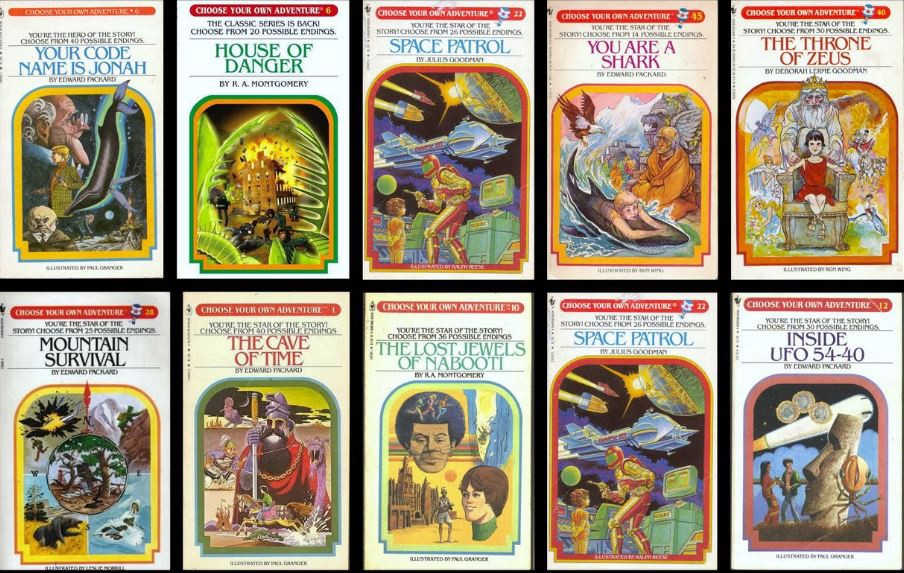
Adults who were children when I was, or possibly a little younger, will remember the old Choose Your Own Adventure stories. I remember the first time I stumbled upon one of these, and it was absolutely riveting. It was about at town called Deadwood, though whether it was Deadwood city or simply Deadwood, I cannot remember. I thought it was completely brilliant at the time, and eagerly devoured or of the choose your own adventure series as fast as I could check them out from the library.

Now that I am an adult, two questions occur to me: the first 20 being, why have I never seen my own children reading Choose Your Own Adventure books? I don’t know when they stopped being actively published. Indeed, for all I know, they may still be actively published, and I just don’t see them. I do know that near the time I was in middle school, in the late 1980s, some publishers, most notably TSR, had added dice rolls to the narratives, and turned them into what were effectively solo role-playing games. In fact, last year a friend of mine sent me, as a Christmas present an adventure that was, essentially, one of these role-playing books, which I believe was funded through a Kickstarter. It seems likely to me that the advent of cheap video games which were far more engrossing and the rising popularity of formerly nerdy hobbies such as Dungeons & Dragons is likely the reason that these books lost their popularity among school-age children. They simply had other things that were better for scratching that choose your own path itch. I have seen, however, that the “visual novel” style of videogame in which the story is everything and actual tactical, strategic, and reflexive combat is nearly nonexistent seems to herald a rebirth of these old books in a new way.

The other question that I have is a bit more complicated: why have such books never been thought appropriate as actual literature? It seems to me that there is nothing inherently less challenging in the format, and while almost all the books of this type that I have read have been aimed at children, there is really no reason that it would always have to be so. Science fiction, fantasy, and superhero comics have all, at one time or another, been denounced and ridicule as the literature of children and the mentally deficient. And yet, now, in the 21st century, they have become, more than ever, part of the mainstream literature. We even call the comics “graphic novels” now.

So, what say you, readers? Do you think there is a place for serious branching paths literature? Can the reader discover great truths in such a work? Can a writer discuss profound questions of choice, consequence, philosophy, and other matters of substance in such a format? And if not, why not?

Oh, and most importantly of all. IF I WROTE SOMETHING LIKE THIS, WOULD YOU READ IT??

I would very much be interested to hear your responses.

Eldros Legacy: RHENN THE TRAVELER

Tomorrow, a novel that I am really extra-excited about releases, which is Todd Fahnestock’s Rhenn the Traveler. Rhenn was, in a sense, along with, Khyven, the major protagonist of first book in the Eldros Legacy, Khyven the Unkillable. Now, Khyven the Unkillable is quite possibly the best sword and sorcery novel that I read last year, and its sequel, Lorelle of the Dark, was in every way a worthy follow-up. So, I know what I am reading for my next novel of the year, and I hope you will too. I will not lie to you and say that this choice has nothing to do with the fact that I, too, am working on and Eldros Legacy novel, but even if that were not so, I would have been glad to read these books. You can buy Rhenn the Traveler here starting tomorrow or preorder today!

AVATAR 2: The Way Of Water SCRIPT RELEASED

So since I got so many hits from the Top Gun script satire, I figured it would drive traffic to do a post that would 1) distract pirates, but more importantly 2) give my fans a laugh. So, here goes the script that I am sure no one would ever predict from Dances With Smurfs 2, Digital Bugaloo. It should go without saying that, like my last review, I have written this one wthout ever having seen, or planned to see, this film.

The Place: The Smurfelf (or Na’vi or Nauvoo, or whatever) Homeworld

Scene 1:

JAKE SULLY (voiceover): Life has been so perfect on this alien world where my family has either overlooked or never known the fact that I’m an alien hiding out in the mindwiped corpse or brain-ectomied clone of one of them.

JAKE’S SON: Hey, Dad, how come you never talk about your childhood. You’re not hiding some deep, dark secret, are you?

NEYTIRI: What a question to ask your father!

JAKE’S SON: Just kidding!

JAKE SULLY: I hope I never have to confess my deep, dark secret to them.

NEYTIRI: Oh, I’m sure that will never be necessary; we showed your people that trying to conquer our planet was hideously unprofitable last time, right?

JAKE SULLY: Yes, you’re right. It would just be pure evil of them to try again. In fact, no matter how rare the substance, it’s overwhelmingly likely that synthesizing it would be far cheaper than launching an interstellar invasion.

Despite the fact that there is no sound possible from outside the atmosphere, an ominous whisper of sound accompanies a distinctive flash of light in the sky.

JAKE SULLY: Well, shit.

Scene 2:

JAKE SULLY: …so that’s the reason, children, that I’ve never talked about my childhood, and by extension, is my deep, dark secret.

JAKE’S DAUGHTER: So, you’re really an alien midget who can’t walk riding my Dad’s body around? I can’t deal with this!

NEYTIRI: No, that’s… how can I explain this?

JAKE’S DAUGHTER: You’re a lot kinkier than I ever imagined?

NEYTIRI: No, I…

JAKE’S DAUGHTER runs off crying.

NEYTIRI: What will we do, Jake?

JAKE SULLY: Well, on Earth we had these people called ‘therapists.’

JAKE’S SON: But why would your people come here and attack us?

JAKE SULLY: Because my people have developed a terrible technology that gives them great power, only at the cost of needing to constantly destroy everything beautiful on their world, and now they will do it to ours as well!

JAKE’S SON: And that’s why they developed this soul-destroying technology?

JAKE SULLY: Yes, they are terrible.

JAKE’S SON: Well, why can’t they just get everything they need just like we do by plugging themselves into your planet’s animals and mind-controlling them?

JAKE SULLY: Well, no. They can’t do that because they’re inferior.

JAKE’S SON: What are we going to do??

NEYTIRI: Don’t worry, your father can just lead us all to triumph again, I’m sure. Can’t you?

JAKE SULLY: This might be a good time to discuss how Earth militaries occasionally learn something called ‘tactics’ and the fact that they probably remember our capabilities from last time.

Scene 3:

Fire and death raining down from the sky. Everyone but the Sully family is exterminated.

JAKE SULLY: Neytiri! Take the children and go!

NEYTIRI: Not without you!

Explosion conveniently knocks Jake out of the sky in a dramatic fall which will provide tension to everyone in the audience with brain damage and who has never seen a movie before.

Scene 4:

JAKE SULLY: What happened?

JAKE’S SON: We lost everything! Everyone is gone!

NEYTIRI: You were knocked out and I saved you. Fortunately, you hit several plot devices on the way down.

JAKE SULLY: Oh, good.

JAKE’S SON: I thought you said these aliens were inferior!

JAKE SULLY: Yes, look at what they did with their soul-destroying technology!

JAKE’S SON: And you grew up with these people and they can travel between stars and wipe us out like that and you knew about it all these years and you never thought to teach us any of it?? It looks like what we Na’vi need is a double-helping of soul-destroying technology!!

JAKE SULLY: Now, son, all we need to do is discover how this planet will provide us some new animals that will surprise the aliens again that are compatible with our USB brain plugs.

JAKE’S SON: But who will take us in?

Scene 5:

ATTRACTIVE STRANGE GIRL: Hey, new people! We’ll take you in! Come live with us!

JAKE’S SON: Really?

NEYTIRI: Of course, all Na’vi are one.

ASG: Come join our Water Tribe.

NICKELODEON LAWYERS: a-HEM!

ASG: I mean the Sea People! We will be happy to teach you everything, despite the fact that you have no skills that are useful in this area and will probably attract the very people who attacked you.

Scene 6:

EVIL COMMANDER: Are you sure Jake Sully is dead?

LIEUTENANT: Sir, why does that matter? We wiped out his whole tribe.

EVIL COMMANDER: Because only a human could ever defeat us. We tracked him with our bioscantrackerdoohickey.

LIEUTENANT: Can’t we do that again?

EVIL COMMANDER: Only if he’s not underwater.

LIEUTENANT: Geez, what are the odds?

Scene 7:

The training montage that takes place underwater

Scene 8:

LIEUTENANT: No trace of him, sir.

EVIL COMMANDER: Dammit! Well, might as well go mine the biggest deposit of unobtainium on the planet. Where is it?

LIEUTENANT: Underwater, sir. Right here.

EVIL COMMANDER: Geez, what are the odds?

Scene 9:

JAKE SULLY: Son, can you ever forgive me that I wasn’t who you thought I was?

JAKE’S SON: I guess, Dad. I mean, all that matters is who you are inside, which just happens to be a White Savior icon that we poor natives needed to save us, in spite of which you wouldn’t teach us your technology, because our souls aren’t strong enough, I think.

JAKE SULLY: That’s not…

JAKE’S SON: But all we’ve done is prepare to use a bunch of really cool fish in combat! What if the aliens attack anywhere else?

JAKE SULLY: Look, son, they attacked in the air when we had birds; they’ll attack in the sea now that we have fish.

JAKE’S SON: That doesn’t make…

ASG: They’re coming!

JAKE’S SON: Geez, what are the odds?

Scene 10:

Invincible-looking human armada approaches

THX SURROUND SOUND: BWAAAAAAAAAAAAAAAAHHHHHHHHHHHHH!!!!!!!!

Impressive-looking Na’vi fish school looks Grim And Determined.

THX SURROUND SOUND: BWAAAAAAAAAAAAAAAAHHHHHHHHHHHHH!!!!!!!!

LIEUTENANT: Sir, we have his signature: It’s Jake Sully!

EVIL COMMANDER: Today we discover which species is truly superior!

90% OF THE MOVIE BUDGET IN 5 MINUTES: KA-BLAMBOOMSPLASHAIIIIGH – NO! – GABAMFKABLOOEYBAM!

EVIL COMMANDER: You may have defeated us, Sully, but we will return!

JAKE SULLY: You’re going to keep throwing money away on this planet?

EVIL COMMANDER: You will never defeat the corporate drive for profit!

JAKE SULLY: Geez, you guys really are cartoon capitalist villains, aren’t you?

EVIL COMMANDER: Us? I meant Cameron. There’s no way he’s walking away from this cash cow (dies)

END CREDITS

For Reacher Or For Poorer (SPOILERS)

So, having Amazon Prime, and having had it recommended to me by someone whose taste I generally appreciate, I decided to semi-binge REACHER this week, the adaptation of the Lee Child character of the same name. Reacher is an ex-Army major who headed a Special Investigations unit in Iraq. He’s kind of a cross between Sherlock Holmes and The Terminator, and he is arrested for the murder of two men, one of whom ends up being his own brother.

Oh, Reacher. There is SO MUCH to like about this show. The pacing is excellent, building tension and maintaining suspense. The characters are well-developed, portrayed by a wonderful cast. Alan Ritchson plays the title role like a laconic Chris Evans if he looked the way Starlord wanted to when he met Thor. Malcolm Goodwin is essentially reprising his brilliant role from iZombie, but played straight, and he’s his own variety of cultured badass. Willa Fitzgerald’s Roscoe Conklin is dangerous and sexy as hell. The dialogue is clever to the point of brilliance. To take one of my favorite examples:

Town punk: “You’re about to get your ass kicked.”
Reacher: “No. I’m about to break the hands of three drunk kids.”
Town punk: “There’s four of us.”
Reacher: “One of you has to drive to the hospital.”
Three broken hands later
Last punk: “I know where the hospital is!”

But then we get to the gaping, gaping problem. Which is, for want of a better way to say it, the way the world works. We are asked to believe that Joe Reacher is an agent of the Secret Service. Not just an agent, though, but the director of the entire anti-counterfeiting branch (which is, of course, one of two things the Secret Service absolutely specializes in), and he’s taken this case himself.
As it develops, Joe was chasing down a huge counterfeiting operation inside the United States. We are asked to believe:
1) That Joe Reacher had NO subordinate agents working for him on this.
2) That when Jack and some city police officers call the Secret Service to report this to another agent, that agent immediately tells them all about what Joe was doing, and is willing to bring them his private files. Because apparently, security clearances aren’t a thing.
3) But most of all, that when a Secret Service director is murdered, and THEN another Secret Service agent is murdered, Homeland Security’s reaction is apparently nonexistent. They just… don’t react.

It is a testament to just how good this show is that this does not ruin the entire thing for me. I have quit watching lesser shows in the middle for this kind of bullshit. I’m sorry, but the idea that criminals or foreign nationals could simply murder a law enforcement officer of this rank to zero reaction from the federal government is almost equivalent to Pearl Harbor being bombed and the United States ignoring it. They just couldn’t do it, at least not without serious justification.

Anyway, despite that, I’m hooked. This is the first show since Stranger Things I’ve binge-watched this fast. Hope Season 2 is even better.

ATTENTION PARENTS! COMMUNIST PLOT TARGETING YOUR CHILDREN: Goodnight Moon.

Having read the classic children’s story “Goodnight Moon” to my son for many many nights now, I am most disturbed to report that I can no longer expose my son to this horrific piece of propaganda. Its innocence belies the sheer malignity of its purpose, which is no less than the complete destruction of American society, and the establishment of a godless and communistic State. In order to appreciate fully the subtleties of the work, I will need to reproduce the text, here. I cannot do the same with the pictures, so just grab a copy and follow along… IF YOU DARE.

Page 1

“In the great green room
there was a telephone
And a red balloon.
And a picture of–“

Okay so firstly, why does a child of this one’s age (less than five, I would think… would an older child actually be talking to inanimate objects?) require a telephone? An intercom might be understandable, but a telephone? Surely if the child had an important phone call, his mother, or at the least the mysterious “quiet old lady whispering hush” (q.v.) would wake him. Therefore the reader can only presume that the entity responsible for the installation of the telephone was one that both wished direct access to the child at all times, and was powerful enough to demand it, i.e. the State, which is seen as normal and even comforting in this tale of innocence at bedtime.
It is perhaps also interesting to note that the room is described as GREEN. Why? The walls are green, yes. But the curtains are yellow, and the floor and furnishings are red. Obviously, this is an attempt to make green into a friendly and unthreatening color, and an attempt to foist a radical anti-capitalist environmentalist agenda onto American youth. And the red floor? Obviously a code showing that all such politics must spring from the firm foundation of Marxism-Leninism.
The balloon is another communistic reference, possibly calling for immediate war with the west, as in: ‘the balloon is going up.’ If so, the authors’ opinions seem to vacillate as the balloon disappears and reappears throughout the work.

Page 2
“The cow jumping over the moon.”

Goodnight Moon was published in 1947. The cow jumping over the moon symbolizes the author’s hope that Soviet Russia would win the Space Race.

Page 3
“And there were three little bears sitting on chairs.”

The three little bears are obviously a reference to Russia as the leader of the Communist movement. Lenin and Stalin would be two of the bears. The third may be Trotsky, but it is more likely that the author at the time believed that Mao Zedong would continue to foster tight relations with Moscow.

Page 4-5
“And two little kittens
And a pair of mittens.
And a little toyhouse
And a young mouse.”

The kittens, significantly, are black and white, signifying the “black” capitalist forces fighting Mao’s armies and the “white” forces already defeated in the Russian Civil War. Their reduction to annoying housepets suitable for distracting the people is very much in the style of Socialist Realism’s heavy-handed satire. The mittens and the socks are pink, considered an appropriate color for the child, whose very thoughts will soon be clothed in socialist-leaning terms. The toyhouse is also, significantly, red. The mouse, of course, would be considered dangerous vermin in most cases. Obviously the authors realized that Soviet housing was rife with these pests and are conditioning their young readers to accept them as inevitable.

Page 5-6
“And a comb and a brush and a bowl full of mush.”
“And a quiet old lady who was whispering, ‘Hush!'”

Why a comb AND a brush? The redundancy is unquestioned. One of these objects is probably a listening device of some kind. Again, the child reader is being conditioned away from questioning such cognitive dissonances. Most chillingly, the “quiet old lady” makes her first appearance. She is not named as any relative, nor does she have any interaction with the child but to silence him. Obviously, the authors wish to instill silence as a virtue in the compliant subjects of the State, and to accept any authority figure presented by that State as legitimate ipso facto. She knits a green cloth, the makeup of which the black and white kittens attempt in vain to tangle.

Nothing further seems to be going on for the next four pages, but…

Page 11-12
“Goodnight light
And the red balloon
Goodnight bears
Goodnight chairs”

Note the child’s body position, here, kneeling on the pillow before the seated bears. Communist “prophets” are being substituted for bedtime prayer, and elevated to godlike status.

Page 13-14
“Goodnight kittens
And goodnight mittens”

What happened to the socks? They have disappeared from the rack. They show up later, of course, but this again reinforces the idea that the State alone will choose the context and syntax of information shown to its subject. Consistency is not required.

Page 14-15
“Goodnight clocks
And goodnight socks”

As a child this age, I don’t believe I had one clock in my room, let alone two. the child is being trained to conform to the cold, mechanistic schedule of the State, and accept it as natural.

Again, nothing significant for the next four pages, but then…

Page 19-20
“Goodnight nobody
Goodnight mush”

The child says goodnight to “nobody,” an indication that agents unknown are always watching and should be accounted for by the wise (read “terrified”) subject of the State. And of course the “mush” again, is conditioning the child to the reality of collectivism: bland porridge will become the staple meal of the populace, as it is one of the cheapest foodstuffs that any society can produce.

Page 21-22
“And goodnight to the old lady whispering ‘hush’

Again, the acknowledgment that the servants of the State, seen and unseen, are always with us.

Page 23-24
“Goodnight stars
Goodnight air.”

This looks innocent, but in some ways is the most haunting propaganda image of all. The stars and the air, two things that even the State knows it cannot hope to control, are presented. Alone of all the full, two-page illustration, this one is colorless, a washed out and Siberian snowscape. The message is plain: an escape to nature is an escape to sterility, exile, and death.

Page 25-26
“Goodnight noises everywhere.”

Noise, and any form of rebellion, is, chillingly, everywhere extinguished. The “quiet old lady’s’ eternal ‘hush’ has succeeded in stilling every form of dissent. And this is presented as a comforting truth to put children to sleep with. A few other factors deserve consideration: Note that the telephone alone of all the objects named is never said goodnight to. Obviously, it is for the State to contact its subjects, and not the other way around. Also, the books on the bookshelf move around, a reminder that knowledge is under the sole control of the State. It may change at any time, and these changes are not to be questioned.

I know that this post is, well, disturbing. I was certainly disturbed when the awful truth broke in upon me in the middle of reading this book to my son after two nights of no sleep and about forty-seven cups of coffee. But the awful truth is no longer possible to ignore. How Brown and Clements escaped the vigilance of HUAC in the fifties I will never know. The truth is self-evident.

Movie Reviews Far Too Stupid: Monsters and The Ruins

You know, what really makes me want to tear my own throat out as a writer sometimes is when I see that, despite the enormous number of wonderful novels that would make great movies, people keep making films based on ideas that should have been shot down in a high school Creative Writing I class. So to illustrate this, a pair of movies that I couldn’t even finish. And because they deserve no better, spoilers do exist:

First: The Ruins

This one actually started off really well, which was why the subsequent idiocy was even more disappointing: Team Disposable 5 (Jock, Nerd, Clown, Slut and Virgin. Thank you, Cabin In The Woods) go out to an old “Mayan” ruin, where Jock’s brother is supposed to be digging. They are surrounded and forced into the ruins by creepy tribal “Mayans” with guns and not allowed to leave. They quickly discover that they are under attack by carnivorous plants, and the Mayans are really quarantining them so they don’t spread the stuff. So far, it’s really good.

Here’s where I got turned off. Jock is the first casualty, and breaks his back, leaving him paralyzed. Early in the second day, Nerd (who is in med school — or maybe is just accepted to med school, it’s unclear) nominates himself the leader and decides that the only way to save Jock from sepsis is to amputate his infected legs. While they have nothing but a pair of tourniquets and a pocket knife.

Yeah, no: I’m out right there. I don’t believe this asshole could even get into med school, and I don’t believe anyone would go along with it. I don’t believe Clown doesn’t just punch this moron out an try to run for help, especially since no help is known to be coming. It’s obviously an excuse for serious gore and screaming, and I’m done.

But these guys are geniuses compared to whoever wrote Monsters.

So, yeah: a NASA space probe fell on Mexico awhile back and infected it with giant squid kaiju. The “infected zone” (i.e. Northern Mexico, which conveniently didn’t spread north of the US border) is quarantined. Gas masks are for some reason ubiquitously distributed to the poor just outside the Quarantine Zone (in case what? Someone inhales a case of kraken?) and the US military and reporters are dispatched to contain and record the invasion.

The storyline before I turned it off was that Reporter Hero is ordered by his boss, Magazine Owner, to rescue Magazine Owner’s Baby Girl (age: 22-25), who is there for No Discernible Reason and was mildly wounded in a Squid Kaiju Attack (OUTside the QZ. Why does the QZ exist, again?) and to escort her back to the USA. So, we’re supposed to believe that Magazine Owner who is willing to pay $50,000 per shot of kaiju-killed kids won’t charter a private jet with trained security squad to fly down to Mexico to get Baby Girl away from the kaiju, but instead will simply bully Reporter Hero on the scene into buying said Baby Girl a $5K ticket on a refugee ferry up the Baja coast. Sure. Because that’s what people do. In the same scene he’s buying the ticket, refugees are lined up to be “escorted” across the “Quarantine Zone” to the US.

And that’s where I was out. The producers/directors obviously don’t understand that quarantine might mean something in an alien invasion, or that rich people would spend money to save their loved ones effectively. The script also contained such gems as:

Reporter Hero: So, you’re married?
Baby Girl: Engaged.
Reporter Hero: What’s the difference?

Although I have to admit liking the exchange that went:

Baby Girl: Doesn’t it bother you that your job relies on terrible things happening?
Reporter Hero: You mean like a doctor?

Or a soldier, policeman, firefighter, safety regulator, health inspector, et multiple cetera…

Please, friends. There are ways, MANY ways to get your drama without relying on idiot plots like these.

Don’t Hate The Catcher, Hate The Game

So, I did something this weekend I’ve been thinking about for a couple of decades, and reread The Catcher In The Rye, which I haven’t touched since I was forced to read it in high school. Honestly, the most memorable part of the book for me was Holden’s rant at the end of the book about the kind of people who feel the need to write “Fuck You” on blank surfaces. Other than that, the book was fairly unmemorable for me, but then I was in a conversation where the book came up and a few people said that they hated Holden Caulfield more than any other character in literature.

I didn’t remember hating Holden Caulfield all that much when I read the book. I just remembered thinking that he was kind of an asshole. But I also thought that maybe, just maybe, being the staple that it is, the book deserved a reread from an adult perspective rather than the self-centered teenager that I was when I was forced to read it.

Having read it again from a middle-aged perspective, however, I can now say with confidence that Holden Caulfield is, in fact, still kind of an asshole. He’s pretty emblematic of the kind of asshole that comes from rich, urban families: the kind that has absolutely no inkling of what real need is and is obsessed with criticizing all his peers and family because, (ugh!) his rich brother who writes for Hollywood and the guys at his private prep school keep wanting to do things that they care about for Chrissakes, without realizing how stupid they are.

Of course, Holden is just fine with screwing up what other people want to do — his own school’s fencing team, for example — and his own education by refusing to study for anything, and never once considers that refusing to participate in the games of life that he so despises might be even dumber than participating in them. He merely goes on with his suffocating sense of superiority in having “seen through” everyone else’s phoniness. Of course, there is absolutely no way for anyone to prove to Holden that they aren’t phony (although, to be fair, he doesn’t seem to think everybody is: Holden at least has the virtue of taking innocence seriously) but he rarely thinks that the problem might be him. He thinks he’s pissed off because he is where he is, but he’s really pissed off that he isn’t who he isn’t. Holden never considers that anyone might actually have a reason to be invested in anything that Holden doesn’t personally value. He assumes the worst of everyone but himself all the time, and assumes the worst of himself half the time.

In other words, Holden is the typical teenager, but the “loser” variant: He’s unpopular with his friends because he doesn’t really do anything, won’t pick up on social signals like ending conversations, and talks loudly enough to piss them off — except he always seems to have friends. This, by the way, is where I call bullshit on the novel: any kid who acts the way Holden acts wouldn’t have ANY friends except guys exactly like him, and Holden manages to be hanging out with at least three girls plus a couple of guys over the course of the novel, and everyone always has time for him. This makes Holden a kind of depressing Reverse Gary Stu: he THINKS he’s better than everyone else, while clearly being worse, AND YET people still talk to him. This seems rather clumsy for a writer of Salinger’s stature, but I mean, he’s also got Holden telling us that he breaks his hand punching in car windows while not cutting hell out of the same hand. And he meets a guy who has a Memorial Wing of a private school named after him while he’s still alive, and I’m pretty sure both of those things are bullshit, too.

Now, “loser” teenagers usually straighten up after a couple of hard lessons and progress toward more-or-less functional adulthood at least: there’s no real shame in being one, and Holden, let’s be honest, has had a bit harder a road than most rich kids, having lost a brother to leukemia and a classmate to being (likely raped and) murdered. So I can’t say that I hate him, or even think terribly badly of him: he’s just a kid, acting in the way that a lot of kids do. A slave to his feelings: looking for sex, looking for love, looking for friends, drinking when he can to ease the pain, and pretending he’s a lot older and smarter than he is, judging the people he wants to keep him company.

The question I’m left with is, what the hell makes Holden Caulfield so special? Holden has become this rather-tiresomely-repeated “symbol for teenage rebellion,” that “captures the experience of being a teenager,” butr it’s so mundane that it could be ANYONE. So why this guy? Holden is a literary Kardashian, famous for being famous and having the right friends and money. I can see no more reason to care about Holden than I would care about Stradlater or Sally except for the fact that Salinger chose to shove Holden in our faces.

Moreover, Holden plainly is everything he’s rebelling against, and he’s rebelling mostly by doing nothing in particular except throwing around money and endlessly discussing the most average insights as though they’re profound truths, and trolling those more successful and popular than him and utterly failing to get laid, while bitching about how the people that actually can are bastards. While messing around with this bog, I found a fairly well-written piece that claims that Holden is actually protesting against sexual assault. But the flip side of this is that Holden still wants sex from the same women, he just doesn’t get it because, well, because Holden is a nice guy. Holden’s white-knighting while complaining places him as sort of an eerie incel of the fifties,* who even prefigures the incel-lingo of “Chads” and “Stacies” by referring to people in magazine stories as “Davids,” “Lindas” and “Marcias.”

Look, this kid is about sixteen. I can sympathize with the kid and his pain and frustration, sure. But take him seriously? Who with an ounce of sense would? Holden Caulfield talks like a pothead without the pot. The Deep Philosopher of the School of It Stands To Feel without actually having done the work of reasoning and understanding philosophy. He is, as Wolfgang Pauli is supposed to have remarked about a physics paper, “not even wrong.” He doesn’t have even the beginnings of a framework to make the moral judgments he’s pronouncing.

I really can’t imagine what kind of person could have ever read this book and found it entertaining, let alone profound, except… no wait: this is Maury Povich for pseudointellectuals, isn’t it? It’s so popular in English departments and among English teachers because so many guys in the English dept. ARE Holden Caulfield. And since I have two degrees in English, I think I might have a clue as to what I’m talking about: so many of them are absolutely contemptuous of everyone and everything because they think they have risen above “the common taste.” Only where I read books and dreamed about riding starships and dragons, as far as I can tell, when most of these guys read books, they hoped that one day they would be the guy with all the drugs and the broody sexiness and instant intellectuality, which is just sad. And Holden is simultaneously their model, while failing to be what they want to be. So, yeah, they can aspire to be the better version of him: it’s watching Maury for people who think they’re too good to watch Maury.

The sad part is that Holden is almost offered (though it’s questionable whether he would take) an epiphany by Mr. Antolini, who warns Holden of the danger he is most certainly in: the danger of declaring yourself disillusioned before you were ever illusioned, and of disdaining paying society’s dues because it seems unprofitable and mundane.

But just then Salinger immediately undercuts this by having Mr. Antolini behave in a way that is at least inappropriate toward Holden, and is probably a sexual advance. So where does this leave us? Well, it conveniently leaves Holden as the only remaining moral authority in the book, able to freely disregard Antolini’s actually good advice.

The problem is not Holden the catcher. The problem is that Salinger has made it impossible for Holden, the Catcher in the Rye, to win any game. All the potential victories are poisoned, all the possible goals false. There is no consummation, there is only masturbation: the fruitless and hollow comfort of having been right never to trust and never to try. And I can’t help but think that’s what the goal was all along: for Salinger to propagate despair and pat himself on the back for it. And far too many people have bought into his game.

*And holy shit, how is there discussion of Holden Caulfield being gay? I mean, that takes some world-class projection: he’s punching his roommate for maybe feeling up a girl he likes, hiring whores, and desperately proposing marriage. And this guy is gay? Yeah, in a world where Gertrude Stein and Alice Toklas were “just roommates,” maybe.