The Lord Of The Rings, Forgotten Conversations

Sometime around Bilbo’s fiftieth birthday.
Gandalf: “Hey, can you save me and a dozen idiot dwarves and a hobbit from wolves and orcs?”
Gwaihir: “Sure.”

A few months later.
Gandalf: “Hey, can you save a dozen idiot dwarves and a hobbit from wolves and orcs despite the fact that the morons wouldn’t be in this situation if they’d just split off some treasure for some folks who frankly earned it by slaying the dragon they stirred up?”
Gwaihir: “Sure.”

About eighty years later
Gandalf: “Hey, can you save me from the tower of an evil wizard powerful enough to lock me up in it?”
Gwaihir: “No problem.”
Gandalf: “Hey, while we’re on the subject, can you save the entire continent from literally the most evil being on the planet? The only thing he has that can fly are on horses hundreds of leagues west of here. You just have to drop us off at the big mountain.”
Gwaihir: “Fuck, dude, we’re not your taxi service.”
Gandalf: “Okay. If I call you in about a year, can you pick up a couple of hobbits for me out of Mordor?”
Gwaihir: “Sure.”

The Hopeless Defense Of Susan Pevensie

If there is one thing I have learned in my life about arguments — and would that I had learned it sooner — it’s that there are some where you’re just not going to win. The issue has long since been decided before you ever entered the room. In fact, you’re not even witnessing an argument so much as the self-congratulatory talk after the argument has been decided against you. And you are as welcome in such venues as a drunken Rams player would be trying to get the Patriots’ defense to line up for one more play while Tom Brady is holding the Vince Lombardi trophy.

The only possible reason to keep arguing in such a case is if enough undecided observers are present that they might be swayed: Internet arguing is a spectator sport. But if the vast majority of spectators are Patriots fans, then you might as well not bother.

It’s a cheat, of course, because unlike sports games, there’s no timer. And the people involved in such arguments always want to appear as if they are fair-minded and brilliant, annihilating their opponents with superior knowledge, while in fact they are simply guarding their preferred outcome. To do this, they will characterize their opponents’ arguments in emotional terms and then admit the proper half of the facts into evidence while denying the other half. They will then congratulate themselves on their subtlety and insight, while mocking you. As I’m sure you’ve gathered, I got into the edges of one of these earlier this week and quickly showed myself the door.

The issue in this case was a defense of Susan Pevensie as the true hero/victim of the Narnia chronicles, because she was the only one who grew up and told the tyrant-king Aslan where to stick it. I suppose it shouldn’t be surprising that one could read Narnia this way: people have been reading their pet philosophies into works of literature since Blake and Shelley declared Satan to be the true hero of Paradise Lost.

I could tell I was on the wrong team when I made an observation that Susan Pevensie had given up on Narnia and was immediately told that this read of Susan’s character had made the respondent furious. This was also the first indication I had that there was even going to be an argument. It was immediately supplemented by others’ contentions that a) Susan had not given up on Narnia, but had rather been kicked out of Narnia for growing up and becoming a contemporary young woman and that b) Aslan was a God who didn’t want anyone in heaven who had grown up, and that c) she had gotten kicked out for discovering lipstick and stockings and courtship and marriage and d) because of that had her entire family taken away from her.

Of course, the only way you can get to this reading is to believe that everyone else in Narnia is a complete and utter liar who hates Susan from the outset. Such a thing may be true, I suppose, but it very much involves reading that into the text rather than reading any part of the text itself.

Firstly, any reading of the text will show you immediately that “growing up” was no bar to a final re-entry to Narnia/Heaven. Professor Kirke and Aunt Polly were both there, and had, by any reasonable standards, “grown up.” So were the Pevensie parents, who as far as we know, never had heard of Narnia. So the simple process of aging is by no means a bar to entry into Narnia. In fact, when Jill says “She was always a jolly sight too keen on being grown-up,” Polly (the old lady) responds, “Grown-up indeed. I wish she would grow up… her whole idea is to race on to the silliest time of one’s life as quick as she can and then stop there as long as she can.” Susan’s fault is not in growing up, but in embracing a false notion of what ‘growing up’ means. The only way this equates to becoming a contemporary young woman is if we admit that such women are defined by their acceptance a false notion of adulthood. Hardly a flattering notion

Did Aslan, then, bar Susan from re-entry to Narnia/Heaven simply for being a young woman who liked the idea of looking pretty and getting married? Again, not at all. Susan’s real fault is that she has decided that Narnia was merely a game. According to Eustace, when Narnia is brought up, she says, “Fancy your still thinking about all those funny games we used to play when we were children.” Susan simply no longer believed. And since she no longer believed, she could not be brought into Heaven, any more than could the dwarfs who would not be taken in. By contrast, the rest of the Friends of Narnia believed and took action on behalf of Narnia in the real world, by mounting an expedition to get the traveling rings.

Finally, did Aslan take away everyone from Susan? In a sense, I suppose He did. On the other hand, her absence from the rest was very much her choice, so I suppose that everyone was “taken away from her” in much the same sense that a high-school dropout by choice “loses all his friends” when they graduate and go off to college and the professional world and never contact him again. It’s more the result of his choices and the way life naturally works. Remember that Susan is the only one still “alive” at the end of the books. Everyone else is “dead.” The argument the defenders of Susan are making is that if Aslan really loved her He ought to have killed her along with everyone else, regardless of what she wanted! In a sense, all the characters got what they really wanted, and what they believed in. Just like Ebenezer Scrooge got all the money he wanted.

I really would like to believe that Susan, like Ebenezer Scrooge, got a second chance somewhere down the line. But to attempt a defense of her as she behaves in the seventh book is like defending Scrooge as he behaves in the beginning. It requires one to ignore all of the text explored above. It is replacing what is in the text with what is not in the text. It requires one to believe that Susan alone is honest, and her relatives, friends and God are judgmental liars. That there are people are eager to do this, of course, surprises me not at all. They are on Susan’s side, and not Aslan’s, and there is no changing their minds.

It’s probably a bad habit to tack a coda onto the end of the essay, but I will, lest a misunderstanding arise. Justifying the treatment of Susan Pevensie who made the decisions Lewis tells us she made, is completely different, of course, from saying “I don’t like that Lewis made her make those decisions.” That, of course, is completely a fair statement, and one I might even agree with. From an author/theologian’s point of view, I think Lewis was presenting the question of whether one can turn away from grace. His answer is that one can deliberately do so. Then who should have been his example of this? Peter the High King, Edmund the redeemed, and Lucy dearest to Aslan’s heart all would have been more heartbreaking and would have undercut the story more. Eustace and Jill were integral parts of the action in the novel Lewis had just finished. Polly, perhaps, would have been a less heart-breaking option, but also one of much lesser consequence to us. Susan, I sometimes feel, got elected by default.
Fallen Horseshoes To Appear In Anthology!

I’m very happy to say that I got confirmation that one of my earliest published stories, “Fallen Horseshoes” which concerns a blacksmith with a haunted forge, will be reprinted in an anthology this coming year. Details will follow, but for now, I’m going to link to the sample snippet and be happy that this story will appear somewhere other than the back issue of a not-very-well-known magazine.

Handwavio Obviosum: Harry Potter and the Woman Behind The Curtain

Read The Goblet Of Fire to my kids earlier this year, and it struck me that the Triwizard Tournament about which the story revolves is really a great example of an author wanting very desperately to have her cake and eat it, too. If Rowling has a strength as an author, it’s her ability to write characters we fall in love with and hate (because they’re all of us and the kids we went to school with) and her ability to pace her stories to keep us reading.

But she never was a gamer, and she doesn’t understand games. This should have been obvious with her creation of Quidditch, a game that exists for no other purpose but to catapult Harry alone to stardom, by placing him in the position on a team to always, 100% of the time, win (or rarely, lose) the game for his House.¹ And there are no other sports (seriously, when have you ever been to a school where there is ONE sport?) and they never play other schools (which is kind of odd, because there are WORLD CUPS in Quidditch, aren’t there?)

This was never more obvious than the Triwizard Tournament. Granted, Rowling has a serious problem, here: just making Harry the Hogwarts champion by random draw would be a coincidence of the first water, and unbelievable. Of course, she could have had Moody/Crouch make certain of that by using some previously-unknown spell to make him the real champion, but it would have been a dead giveaway since it is indeed only logical that junior and senior (6th and 7th year) students will be the most capable of doing ANY task in a high school. Plus, of course, it loses the entire reason that Cedric can be killed and for Harry to be hated throughout the book.

So Rowling comes up with the whole fourth champion trick. Which serves every purpose except making any actual sense. Consider: the solutions that everyone but Dumbledore arrives at are quite sensible: 1) Don’t let Harry Compete, and 2) Give the other schools additional champions.
When these solutions are proposed, there is a lot of handwaving about some sort of “magical contract” that demands Harry compete, so that we do not pay attention to the woman behind the curtain who does not want the plot to go that way, dammit! But never a word is said about how it will be enforced. The Goblet, having chosen the champions, has no further role to play in the tournament.² There was no reason that Dumbledore could not have agreed to the quite reasonable solution of having Harry operate under impossible constraints (e.g. Giving Harry only one minute to accomplish each challenge). Or, since all the events but the final were judged, and the judges were under no constraints to judge fairly, by simply instructing the judges to give Harry zeroes no matter how he performed.  In fact, it’s kind of out of character that Maxime and Karkaroff don’t do that.
But even so, who does this magical contract punish if it’s not carried out? Hogwarts? How? Harry? Apparently not, because Harry drags his feet over the Second Task and goes into it completely unprepared, and the Tournament makes no move to punish him for his procrastination. This of course would have been the easiest way for Harry to avoid the opprobrium of his fellow students: just refuse to succeed.

So what can we learn from this? I suggest a few basic lessons: Firstly, don’t make things you have no interest in (like sport and games) central to your conflict. Secondly, if you create something like a “magical contract” it needs to have an enforcement clause. Real things have real consequences. Finally, handwaving to make people stop asking questions rarely works well.

¹This would have been easy enough to fix, by the way, and still let Harry do his thing. The obvious solution would have been to make the Snitch catchable by every player on the team and then make Harry a Chaser who was just really good at finding Snitches.

²This also would have worked as a partial fix. If the Goblet itself had magically spawned the challenges, this would have actually made sense. It would not have continued the tournament until Harry passed (or failed) his challenge, and additional challengers would have had no challenge to fight.


NOT QUITE FREE FANTASY STORY!

So, I’m excited to report that with the contract novel delivered to Digital Fiction Publishing League, I’m back on track working on the continuing adventures of James and Harriet, the daring veterinarian (and his lovely assistant witch) of the Evil Dark Lord who rules the world.

Superversive Press, my publisher for this series, has agreed to allow me to post chapters as they are completed, and this will continue until the work is done. And as an incentive to back me on Patreon, I am offering to my patrons the next chapter in James and Harriet’s saga: “The Exanimation Room.”

Now, go patronize me!

Fiction Update: What’s New In My Worlds

I am interrupting your regularly scheduled blog today to bring you news of new and awesome publications!

It’s been kind of a slow year so far for new fiction. I find that frustrating because there’s a whole lot behind the scenes that is in the process of happening, (more on that below) but very little that has actually happened. This means that there’s not a lot new for my readers to read.

So, what I’m doing over on my Patreon Page is I’m launching a new kind of story, a sort of series of humorous vignettes, called “Signs From A Generation Ship.” And we all know the problem: You launch a huge ship across the horrifying void of space on a journey of 1000 years, hoping that your great-great-great-great-ad absurdum-grandkids will get there, but how do you stop them from forgetting they’re on a ship and blowing themselves up when they, I don’t know, try to free God from the fusion reactor, or look for supplies on the other side of that big, sealed double door? What kind of warnings do you post? Here’s a snippet:

Publication BDCH4135M

Location: Helm Station (embedded in the padding, back of helmsman’s chair)

Title: Welcome To The Control Room!

Hello! Judging by the fact that you are ripping apart the chairs, we must assume that you may be the first person(s) to visit the Control Room (or “Bridge”) for quite some time, possibly even for generations. We hope you are literate. If so, please locate a copy of Publication AA1: Your World Is A Ship, hopefully still available in many cabins and public spaces. If you are semi-literate, TAKE BOOK TO READER. DO NOT BURN FOR WARMTH. If not, the flashing red button will play this message in an audio file unless you press it.

This recording is not the voice of a ghost or an evil spirit. It was hidden by your ancestors in case a mutiny or other disaster caused your people to forget their origins. For a detailed description of these origins, please refer to the aforementioned Publication AA1.

In the meantime, the machines surrounding you are very complicated and vital to maintaining your life and that of your children for the foreseeable future, which is why it is so important that you DO NOT TOUCH ANY OF THE BUTTONS OR DISTURB ANY MORE OF THE ARTIFACTS IN THIS ROOM. SERIOUSLY, LEAVE EVERYTHING IN THIS ROOM ALONE! IF YOU TOUCH ANYTHING IN THIS ROOM YOU MAY CONDEMN EVERYTHING YOU KNOW AND LOVE TO A HIDEOUS AND PAINFUL DEATH.

To discover whether you or others before you have already condemned everything you know and love to a hideous and painful death, please complete the following steps:

1) Look at the Astrogation Station. That is the panel with three large screens on it.

2) On the upper small screen, there is a gold circle projected. If there is a star glowing within the circle, please leave the Control Room immediately, barricade it with severe warnings and guard it with your lives until the Voice Of Arrival Protocol instructs you or your descendants what to do. Guard it with your lives.

3) If there is no star in the circle, continue to disassemble this chair. Ignore the pamphlet buried in the column. Flip open the transparent cover and press the large, red button.

4) Use the countdown to pray to whatever God(s) your people revere.

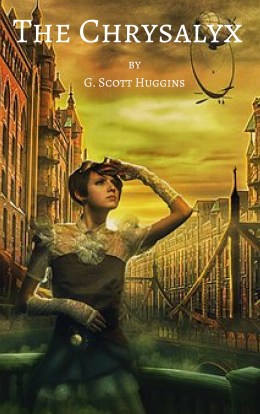
This story will update Monday, Wednesday and Friday on my Patreon until I run out of signs, and is yours for the low price of $1.00 per month. Additionally, you will receive my novelette, The Chrysalyx, a tale of steampunk intrigue in the alternate 1920s, downloadable as a .mobi file.

Chrysalyx Cover Done

So, what’s in the process of happening? Well, what’s coming up is…

  • “All The Colors Of The Darkness,” the story of a girl blinded to keep her from developing her natural talents as a witch, will be appearing sometime this year from Lethe Press in their Survivor anthology.
  • “Crying By Remote Control,” the story of a woman who must use prosthetic emotions, has just been accepted to the anthology Mind Candy 2.
  • On The Wings Of The Morning, an anthology of my no-longer-easily-available work will be coming from Digital Fiction later this year.

Also, the novel I’m working for at Digital Fiction is nearly halfway done.

So that’s it. Please support me on Patreon; I’ll make it worth your while.


How To Tell If You Are In Literary Magical Realism

Firstly, you will notice that something amazing has happened. Not just to you, because then you might simply be insane. And this will not do for magical realism, where everyone must be insane. Or behave like it. No, it must be something incredibly amazing that happens to everyone, like everyone sprouting butterfly wings, or water squirting on people whenever they have bacon and eggs for breakfast or something. Except people don’t eat bacon in magic realism because awareness. Soy.

Secondly, under no circumstances must anyone change their behavior because of this. No one will wear rain slickers when they have soy and eggs. There will be no widespread disuse of bicycles or running shoes because people take up flying.

Thirdly, whatever has happened, it is only really important to one person. Your character. And it will open up his or her or their soul, because this is the person the universe rotates around, and has changed itself to illuminate their one specific problem that is extremely important that no one has ever had to deal with before. Like finding fulfillment. Or falling in love.

Third-and-a-halfly, your character must studiously ignore any larger implications of something amazing, and only ask things like, Grandma, do your wings ever catch on your clothing. And not use quotation marks because decentering spoken discourse challenges the patriarchy or capitalism or something and is really important, okay?
Okay.
Were you talking there?
Who can tell?

Fourthly, The End

Seventhly, make sure there is no resolution of anything.

Sixthly, play with narrative conventions, such as chronological order, making clear you won’t be bound by them or sentence structure grammar because freedom, I mean liberation

Am I In An Epic Fantasy? A Guide

This is the kind of thing that my Patreon supporters get periodically!

This Guide Will Help You Determine Whether You are In An Epic Fantasy.

What kind of person am I?

You are young and single.
Where do I live?
In a small, unregarded village, hundreds of miles from anywhere important.
What’s my job?
Apprentice something-or-other. Or nothing, really.
Who are my parents?
Dead.
What? No, they’re not. I live in their house!
That’s what you think. Be prepared for a big revelation, soon.
How soon?
As soon as the Village Elders talk to you.
What? Why would they talk to me?
It has to do with the mysterious sheep-killings and dark strangers we’ve been seeing about these parts lately.
Yeah, what’s up with those?
And about that mysterious amulet you always wear.
I always wondered about that. Where did that come from?
We never talk about that.
Dammit! That’s what my “dad” always said when I asked.
And you were never suspicious that your parents always referred to themselves in quotation marks?
Dammit. What do I look like?
Like an absolutely typical person in your village, possibly with an atypical (pick one):
Hair color
Eye color
Birthmark
Minor physical defect that in NO WAY detracts from your attractiveness
Do I have a religion?

Yes, but God or the gods, or the Whatever doesn’t really ask a lot of you, or have any commands, or do much at all, except for facilitate Ancient Prophecies that totally have absolutely nothing to do with you or anyone you know (wink, wink!) and that no one actually reads apart from Mysterious Strangers that appear out of nowhere.

Excuse me, but there’s a knock at the door.

Don’t hurry back.

A Character Sketch: Dr. James DeGrande, Or, Why You Should Read Non-fiction

Dr. James DeGrande, my swashbuckling, somewhat evil veterinarian who stars in Superversive Press’s A Doctor To Dragons, has two “ancestors” in a sense. One is Steven Brust’s amoral badass assassin, Vlad Taltos, hero of the Jhereg cycle. Part of the fun I have with DeGrande is writing a similar, no-fucks-given hero, who sometimes ends up doing the right thing.

But the other source is a nearly 100 year-old memoir of the British country vet James Herriot, whose first book about the ins and outs of his practice All Creatures Great and Small, was a world bestseller, spawned a BBC television series along with numerous sequels, and was one of my parents’ favorite choices for nightly reading. I highly recommend it if you haven’t read them.

Part of Herriot’s appeal was that he had an easy gift of describing some pretty arcane veterinary practices so that the layman could follow the drama and the humor that he found in his life, much of which consisted in him being up to the elbow in various farm animals’ intimate orifices at 3 am. And frankly, I liked it for the same reason I liked science-fiction. Because here was a man who really — to me at least — lived in a completely alien world, traveling in a culture I wasn’t familiar with and treating a variety of exotic creatures. Herriot could make cows and pigs sound just as fascinating as any Denebian slime devil.

And so, slowly, over years, the idea of what a veterinarian forced to treat mythical animals would have to deal with percolated around my mind. I will admit that it helped that I married a veterinarian, who could help me with some of the specifics when I write. But that by itself would not have been enough without the love of the stories I grew up with. Thank you, Mr. Herriot.

A Heroic Obedience

Another old Sci-Phi Journal column.

Science-fiction and fantasy tend toward the epic. In science-fiction, the sheer scale of the visible universe inspires the heroic, and in the fantastic myths tend to reward the heroes who single-handedly (or in the company of a band of brothers) take on the gods in the face of certain doom. And thus it is that the heroic virtues are the ones that our genres celebrate. Heroic valor, enduring faithfulness, unstained honor, even chivalric mercy cross our pages and screens.

Whether virtues exist, in any real sense, is one of our oldest debates. Very early on in human – and doubtless in prehuman – existence, we held to the idea that virtues were real. The idea that virtues and virtuous behavior do not exist, because they are a scam to trick the weak and the stupid away from grasping the power that could be theirs, is not very much younger, as anyone who is passingly familiar with Plato knows. From that time to this, the virtues that civilization has been built on have been periodically under assault, often in alternating pairs: thus, near the time of World War I and World War II, mercy and charity were regarded as spinelessness and treason by the great mass of the population. During the height of the Vietnam War, physical courage was often decried as brutality. And as a result of both of those times, one virtue has been beaten so low as to scarcely resemble a virtue at all: obedience.

Obedience receives little admiration from any side of the Western political spectrum, because of the aforementioned recent history, because of the Enlightenment’s valorization of liberty and freethought, but perhaps also because the study of politics concerns the acquisition and use of power to compel the obedience of other people. But that very fact, of course, compels us to take a hard look at the virtue of obedience. After all, what is the purpose of wielding, in Monty Python’s beloved phrase, “supreme executive (or legislative) power” if no one will obey it? Political power is predicated upon the idea that people will obey, and democratic republics are predicated upon the idea that they will obey, at least in the main, willingly. But obeying is not glorious or sexy, and it isn’t a virtue we generally see held up as an example in our heroic science-fictional or fantastic epics.

Of course, obedience features heavily in religious and non-religious myth, the Garden of Eden and Pandora’s Box being archetypal. Perhaps the first epic fantasist to play explicitly with the virtue of obedience near our own time was Milton. And he, writing on the very eve of the Enlightenment, makes of Satan a kind of epic hero that was embraced unreservedly by later Romantic poets. Shelley said that, “Milton’s Devil, as a moral being, is far superior to his God.” What Milton had meant as a tale of lost virtue, they turned into the embrace of a new one: the virtue of defiance. Not defiance for anything, but defiance in sich was taken to be a good.

After the Holocaust and Holodomor of the 20th century showed us the disastrous consequences of unthinking obedience to totalitarian ideologies, we should expect to see a celebration of heroic rebellion spring up. Surely it is no accident that the heroes of the most iconic SF film series of all time are part of “the Rebellion” against an evil and destructive Empire. But the recent crop of Young Adult fiction has developed pure rebellion to new heights. I have already in previous columns addressed Philip Pullman’s His Dark Materials trilogy. Pullman is the heir of Shelley and Keats, preaching defiance against the Authority, and I think the generic nature of his epithet for God is telling. His heroes are not merely rebelling against a bad god, but against the very concept of legitimate obedience. This is taken even further with the more-popular The Hunger Games. Collins first throws Katniss Everdeen against the evil President Snow, who is determined to crush the Districts beneath his heel, even though he already enjoys almost limitless power. But when Katniss discovers the fabled District Thirteen, thought to have been lost in a war almost a century before, its leader, Alma Coin, is almost as cruel and absolutist as Snow himself, enforcing a starkly ascetic military regime. Katniss ends up executing her on the basis of her own suspicion that Coin will seek to assume the powers of the overthrown President Snow. In Katniss’s world, political power and authority quite literally are not allowed to be good, or to act as a moral force. Katniss’s own moral force comes from her willingness and compulsion to disobey (and destroy) every power that would seek her compliance, or even her allegiance. She, and she alone, has the power to determine what is right.

If we look back in the history of SF, however, we find a more nuanced approach from the antecedents of Star Wars, sometimes in the unlikeliest places. In that now almost-forgotten epic, the Lensman series, the Lensmen are cast as the agents of law and order, an outgrowth of the Triplanetary law-enforcement branch, not its military arm. The Lensmen believe themselves to be fighting against “Boskonian pirates,” that is, the agents of lawlessness. Nevertheless it is plain even from the outset that “Boskone” is actually a dictatorial and totalitarian state. The tension between the two is instructive and clear: obedience is an unavoidable virtue. You may not defy the Boskonian terror without obeying the laws of the Galactic Patrol. There is no way to defy one without obeying the other.
Tolkien develops the same theme, although he seemed reluctant to confront it fully. Frodo’s struggle against the Ring is almost always cast as a rebellion and a defiance against The Lord Of All The Rings, and the Ring itself. But in so doing, of course, Frodo is declaring his allegiance and obedience to Gandalf and the rest of the Council of the Wise. To obey them when the way is hard.
It is perhaps unsurprisingly C.S. Lewis and Madeleine L’Engle that come closest to a true celebration of obedience in Lewis’s
The Magician’s Nephew, where the fate of Narnia hangs on Diggory’s obedience to Aslan’s command, although that very obedience involves defying the Empress (and later White Witch) Jadis in the garden. Perelandra is clearest of all, being an allegory of the Biblical story of the Fall as it might have been. But L’Engle’s A Wind in the Door comes to its climax in an act of obedience, a counterrebellion, when the farandola Sporos dares to obey in the midst of his people’s rebellion, heeding the wisdom of the elder fara, Senex, and trusting the authority that says that he must Deepen and undergo metamorphosis to be truly free.

Even in Star Wars itself, of course, this paradox plays out. In order to effectively defy Darth Vader and the Emperor, Luke must obey Yoda. And when he fails to do this, he finds himself effectively obeying his enemies. Our heroes cannot defy without obeying, but they cannot obey without defying.

Heroes who insist on defying without obedience end up where Pullman’s and Collins’s stories leave us, and in each case, the place is not one that any sane person would envy. The protagonists are forever shattered by their victories: Lyra is separated forever from both the boy she loves and any prospect of eternal life, and Katniss, while she is together with Peeta, refuses to lead. And perhaps she must refuse this: becoming a leader would place her in a role of authority, which is evil. It would also entail her allegiance and obedience to law. She cannot truly be a hero because heroes are, almost by definition, those who give of themselves for that which is greater, that which they feel it is worthy to obey.