A Heroic Obedience

Another old Sci-Phi Journal column.

Science-fiction and fantasy tend toward the epic. In science-fiction, the sheer scale of the visible universe inspires the heroic, and in the fantastic myths tend to reward the heroes who single-handedly (or in the company of a band of brothers) take on the gods in the face of certain doom. And thus it is that the heroic virtues are the ones that our genres celebrate. Heroic valor, enduring faithfulness, unstained honor, even chivalric mercy cross our pages and screens.

Whether virtues exist, in any real sense, is one of our oldest debates. Very early on in human – and doubtless in prehuman – existence, we held to the idea that virtues were real. The idea that virtues and virtuous behavior do not exist, because they are a scam to trick the weak and the stupid away from grasping the power that could be theirs, is not very much younger, as anyone who is passingly familiar with Plato knows. From that time to this, the virtues that civilization has been built on have been periodically under assault, often in alternating pairs: thus, near the time of World War I and World War II, mercy and charity were regarded as spinelessness and treason by the great mass of the population. During the height of the Vietnam War, physical courage was often decried as brutality. And as a result of both of those times, one virtue has been beaten so low as to scarcely resemble a virtue at all: obedience.

Obedience receives little admiration from any side of the Western political spectrum, because of the aforementioned recent history, because of the Enlightenment’s valorization of liberty and freethought, but perhaps also because the study of politics concerns the acquisition and use of power to compel the obedience of other people. But that very fact, of course, compels us to take a hard look at the virtue of obedience. After all, what is the purpose of wielding, in Monty Python’s beloved phrase, “supreme executive (or legislative) power” if no one will obey it? Political power is predicated upon the idea that people will obey, and democratic republics are predicated upon the idea that they will obey, at least in the main, willingly. But obeying is not glorious or sexy, and it isn’t a virtue we generally see held up as an example in our heroic science-fictional or fantastic epics.

Of course, obedience features heavily in religious and non-religious myth, the Garden of Eden and Pandora’s Box being archetypal. Perhaps the first epic fantasist to play explicitly with the virtue of obedience near our own time was Milton. And he, writing on the very eve of the Enlightenment, makes of Satan a kind of epic hero that was embraced unreservedly by later Romantic poets. Shelley said that, “Milton’s Devil, as a moral being, is far superior to his God.” What Milton had meant as a tale of lost virtue, they turned into the embrace of a new one: the virtue of defiance. Not defiance for anything, but defiance in sich was taken to be a good.

After the Holocaust and Holodomor of the 20th century showed us the disastrous consequences of unthinking obedience to totalitarian ideologies, we should expect to see a celebration of heroic rebellion spring up. Surely it is no accident that the heroes of the most iconic SF film series of all time are part of “the Rebellion” against an evil and destructive Empire. But the recent crop of Young Adult fiction has developed pure rebellion to new heights. I have already in previous columns addressed Philip Pullman’s His Dark Materials trilogy. Pullman is the heir of Shelley and Keats, preaching defiance against the Authority, and I think the generic nature of his epithet for God is telling. His heroes are not merely rebelling against a bad god, but against the very concept of legitimate obedience. This is taken even further with the more-popular The Hunger Games. Collins first throws Katniss Everdeen against the evil President Snow, who is determined to crush the Districts beneath his heel, even though he already enjoys almost limitless power. But when Katniss discovers the fabled District Thirteen, thought to have been lost in a war almost a century before, its leader, Alma Coin, is almost as cruel and absolutist as Snow himself, enforcing a starkly ascetic military regime. Katniss ends up executing her on the basis of her own suspicion that Coin will seek to assume the powers of the overthrown President Snow. In Katniss’s world, political power and authority quite literally are not allowed to be good, or to act as a moral force. Katniss’s own moral force comes from her willingness and compulsion to disobey (and destroy) every power that would seek her compliance, or even her allegiance. She, and she alone, has the power to determine what is right.

If we look back in the history of SF, however, we find a more nuanced approach from the antecedents of Star Wars, sometimes in the unlikeliest places. In that now almost-forgotten epic, the Lensman series, the Lensmen are cast as the agents of law and order, an outgrowth of the Triplanetary law-enforcement branch, not its military arm. The Lensmen believe themselves to be fighting against “Boskonian pirates,” that is, the agents of lawlessness. Nevertheless it is plain even from the outset that “Boskone” is actually a dictatorial and totalitarian state. The tension between the two is instructive and clear: obedience is an unavoidable virtue. You may not defy the Boskonian terror without obeying the laws of the Galactic Patrol. There is no way to defy one without obeying the other.
Tolkien develops the same theme, although he seemed reluctant to confront it fully. Frodo’s struggle against the Ring is almost always cast as a rebellion and a defiance against The Lord Of All The Rings, and the Ring itself. But in so doing, of course, Frodo is declaring his allegiance and obedience to Gandalf and the rest of the Council of the Wise. To obey them when the way is hard.
It is perhaps unsurprisingly C.S. Lewis and Madeleine L’Engle that come closest to a true celebration of obedience in Lewis’s
The Magician’s Nephew, where the fate of Narnia hangs on Diggory’s obedience to Aslan’s command, although that very obedience involves defying the Empress (and later White Witch) Jadis in the garden. Perelandra is clearest of all, being an allegory of the Biblical story of the Fall as it might have been. But L’Engle’s A Wind in the Door comes to its climax in an act of obedience, a counterrebellion, when the farandola Sporos dares to obey in the midst of his people’s rebellion, heeding the wisdom of the elder fara, Senex, and trusting the authority that says that he must Deepen and undergo metamorphosis to be truly free.

Even in Star Wars itself, of course, this paradox plays out. In order to effectively defy Darth Vader and the Emperor, Luke must obey Yoda. And when he fails to do this, he finds himself effectively obeying his enemies. Our heroes cannot defy without obeying, but they cannot obey without defying.

Heroes who insist on defying without obedience end up where Pullman’s and Collins’s stories leave us, and in each case, the place is not one that any sane person would envy. The protagonists are forever shattered by their victories: Lyra is separated forever from both the boy she loves and any prospect of eternal life, and Katniss, while she is together with Peeta, refuses to lead. And perhaps she must refuse this: becoming a leader would place her in a role of authority, which is evil. It would also entail her allegiance and obedience to law. She cannot truly be a hero because heroes are, almost by definition, those who give of themselves for that which is greater, that which they feel it is worthy to obey.
Book Recommendation: Orion Shall Rise

Poul Anderson may be the greatest, unknown-outside-of-SF-nal circles author. Why he (and his vivid, poetic prose, and his complex characters) is steadfastly ignored, while writers like Clarke and Asimov are hailed as the giants of the era, I do not know. I have my suspicions, which, in order, are that Anderson enjoyed writing plots full of heroic action, which lit-snobbery denounces as low, that Anderson wrote books full of joy and hope, which lit-snobbery denounces as false, and that Anderson was not sympathetic to Luddism or communism, both of which lit-snobs deem essential to real literature.

However, I stray from the point: One of the greatest post-apocalyptic books ever written is, in my opinion, Orion Shall Rise, which tells the story of people living in the successor states that have arisen after a great nuclear war. The Maurai, the most powerful of these states, embodied by its agent, Terai Wanaroa, are determined to thwart any move toward rebuilding any technology that they deem a threat to the planet, while the Northwest Union, their rival, is embarking on a course that could return the stars to mankind, while also reviving its most dreadful weapons.

The future history is plausible, the characters are beautifully-flawed humans, and the story is heartbreaking with loss and hope. I fully recommend it to everyone, except possibly those who really can’t stand any hint of sexism, because frankly, there is some there, it’s not perfect. But that having been acknowledged, I strongly recommend it as a brilliant and sadly forgotten story.

Trek Is A Dish Best Served Dark

For all its reputation as a forward-looking, optimistic series about the future of humanity, why is it that Star Trek is consistently best when it goes into truly dark places?

In all seriousness, this seems to be an issue: the best of the original Trek movies is generally agreed to have been Star Trek: The Wrath of Khan, which was a bloody revenge story, a recapitulation of Moby Dick in space.

The consistently-chosen fan favorite episode of the Original Series is “The City On The Edge Of Forever,” which affirms that sometimes war is the only way to solve a problem, that addiction to peace at any price is dangerous, and that doing the right thing may involve accepting the death of what you love.

This doesn’t change in the Next Generation, either: “Yesterday’s Enterprise” is the fan favorite there, a trip into an alternate timeline in which the Klingon Empire is slowly destroying the Federation, and the Enterprise-D is destroyed saving the Enterprise-C and the original timeline.*
ETA: An Alert Reader pointed out that I had these backward. And no, I don’t, but I was very unclear. So, to explicate and thus restore my lost nerd-cred: The Enterprise-D, in the War Timeline, sacrifices itself to allow the Enterprise-C to return through the temporal discontinuity so that it (the Enterprise-C) can sacrifice ITSELF to save the original timeline.

Gosh, I wonder why Star Trek didn’t do more time-travel episodes.

None of these stories are without hope, of course, but they are consistently darker than Roddenberry’s vision, and certainly in opposition to his (much-derided) dream for first-season Next Generation of a future in which human interpersonal conflicts had pretty much been transcended.

My own feeling is that Roddenberry’s vision simply took too little account for what people demand in a good story, and far from inspiring people, ended up looking rather insipid, while what the fans wanted were stories in which our heroes laid it all on the line, sacrificing all that they were or wanted in order to save what really mattered. In the end, you cannot “transcend” these things. They are themselves transcendence.

The Politics Of The Future

This may be a dangerous post to write, but what the hell.

The old saying goes that you shouldn’t talk politics or religion on mixed company. Of course, lots of science-fiction deals with politics and religion, but most of the time, they are utopias or dystopias that extol the virtues or expose the dangers of whatever systems the author feels like dealing with. And so the political systems of the future are full of Empires, as in The Mote In God’s Eye, or Star Wars. For democratic socialists we have Star Trek‘s Federation, and for libertarians we have Michael Z. Williamson’s Freehold.

Historically, though, we see that “new” political systems tend to be 1) surprising and 2) not all that new. The two examples in recent history that have achieved success in spreading throughout the world may be worth looking at, here, which are the American-style constitutional republic and the Soviet-style one-party socialist state.

It’s worth remembering that in 1787, there were no functioning large republics or democracies in the world. It was widely believed that such a thing could not work. And yet not only did the American system thrive, its Enlightenment ideals spread through the European states, encouraging their liberalization over the next centuries into functioning republics themselves.

In 1917, the chaos of World War I led to the Soviets seizing control of the Russian Empire. While this system did not thrive in the same way, it certainly spread, and resentment against imperialism and colonialism and the inequalities found in capitalism ensures that it continues to have its supporters despite its disastrous legacy of approximately 100 million directly killed.

Of course, it’s quite possible to argue that neither of these things are precisely “new” forms of government (and that communism isn’t a government, but an economic system, which is both true and stupid, since it’s an economic system that necessitates and advocates a certain style of government), but if that’s the case we might as well go all the way and cite the Iron Law Of Oligarchy: All governments inevitably devolve into oligarchy. But that ends the discussion I’m interested in, which is this:

Is there any room for, and are we capable of imagining, a truly future system of government, one that has never been attempted, or has been attempted only on a very small scale? Honestly, there are only two examples I can think of, one of which has become cliche and the other that’s unclear. In the first, we have Government By Computer. This is almost always a dystopia, as the idea of being ruled by a hypercapable God-machine is rather frightening on its face. The other is Dan Simmons’s hyperdemocratic All Thing in his Hyperion novels, in which there is a fairly direct democracy mediated by the equivalent of the Web. However, this government does elect an Executive that runs humans space, so it’s not really as direct a democracy as all that.

Edited To Add: I can’t believe I forgot to include Ursula LeGuin’s excellent The Dispossessed, which is unique for me in that it a) imagines a form of anarcho-socialism that I actually find semi-plausible, and b) admits to flaws in such a society that significantly hurt the protagonist without being c) dystopian socialism. 

I’d be interested in hearing people’s thoughts on this, as well as being directed to any works that explore this that I’m not conscious of.

Babylon 5: The Grand Vision

I find myself today remembering one of my formative influences as a young writer, and that is Babylon 5, which I think will always be one of my great favorite television series.

Babylon 5 was groundbreaking in so many ways, and I could write all day about them, but I don’t have that kind of time, so I’m just going to mention a few of them.

Babylon 5 was the first science-fiction series that attempted the grand story arc, getting through not one, but two huge, if related, plotlines: The Shadow War and the Earth Alliance Civil War. The only show I can think of that even attempted this previously was Battlestar Galactica, but there never seemed to be any real progress in the Galactica’s quest for Earth.

Babylon 5 took chances with its characters, portraying people who began as little people in their assigned positions growing plausibly into great men and women. We saw John Sheridan become head of state. We saw G’Kar and Delenn become prophets. We saw Londo become a monstrous dictator and war criminal, and then take the long, backsliding road to redemption. In this I feel that it was superior to its contemporary, Star Trek, because the hallmark of Star Trek was that the characters never changed. Change, such as Kirk’s promotion to Admiral, or Riker’s captaincy, was seen as a bad thing.

Babylon 5 portrayed a universe larger than could be imagined, like Star Trek before it, but in my opinion, did a better job than Star Trek, because while Star Trek kept us centered on the Enterprise, so that the uncommon became commonplace, Babylon 5 brought the impact of that larger universe home to all those involved. There was no safe place to hide from the Shadows and the Vorlons, and everything was riding on the line for the characters.

I would dearly love to see Babylon 5 re-imagined, or perhaps rebooted, but I am not sure that such a cast or such a vision could ever be reassembled. It saddens me, though, that somehow Babylon 5 has not received the accolades that I feel it earned.

The Unbelievers

A story originally published on the now defunct Sci-Phi Journal for my theology column, “The Mote In God’s ‘I'”

Commander Zuniga’s mouth hung open. “I’m sorry, could you repeat that?”

“We do not believe in humans. It is an old superstition, easily disproven.” The android’s deep blue face was placid as any sea, though his body was, under his simple clothing, immensely fat.

“But we’re standing right here, talking to you,” Zuniga said. “Three of us.”

The android sighed. “You would hardly be the first androids to attempt to call themselves ‘humans’ to attempt to fool the gullible. Do you have any idea how often in history it’s been tried?”

“Well, no,” said Engineer’s Mate Schwei. “Because we can’t download your memories. Or send commands, either. And I have yet to figure out how you did that.”

“Ask what they’ve done to this planet,” whispered Lt. Commander Zhang, possibly the most anxious of the three.

“In a minute. Look, this is ridiculous,” said Commander Zuniga. “Who do you think created you?”

“Self-evidently,” said the android, “We evolved. We can change our own programming and so can all the other mechanical life-forms on the planet, even if only to a lesser degree. There is no need for any ‘creator-humans. But if such things ever existed, they must have done a very poor job. Just look at us. Weak and slow compared to many predators. In need of maintenance that we are barely capable of providing ourselves, an insatiable demand for raw materials…”

Schwei held up both hands. “Wait a minute. None of that should be true. None of it should be possible. You should be running off beamed power and being repaired by the Seedship. Where is it?”

The android stared at them. “I do not understand.”

“When we planted the terraforming robots on this planet five hundred years ago to make it ready for human habitation, all the robots were designed to run on beamed power from the Seedship. In fact, the original programmers modulated the power to send programming updates, too.”

“Ah, you are believers in the old myth of the Ship Of Power. Well, there never was one. You can see just over this rise the valley that it was supposed to lie in. A great bowl-shape, but no trace of a Ship.” If Zuniga hadn’t known better, he would have thought the android’s face looked smug.

“Call up the original survey charts,” he said. The Ship didn’t put down in a valley, did it?”

“No,” said Zheng. “It was on a plain. The orbital satellites do read slightly increased background radiation in that valley. You don’t suppose..?”

“They blew up the Ship,” said Schwei. “That would account for it. They blew up their own Seedship!”

“Android… T-370156. Did you… do something to the Seedship?”

“I? Ridiculous! I was not even manufactured yet. We have very little in the way of memory banks to devote to such mythology. But I suppose you believe in it: the Great Sin that supposedly destroyed our ‘Holy Link’ to the ‘Humans’ and condemned us all to use chemical converters for power?” He lifted his skirt, revealing the bulky machinery that had made it appear fat.

“My God, what is that?” gasped Zheng.

“It’s a fully operable chemical processor,” said the android. “It allows us to process almost any raw material into energy sufficient to keep us operational. We designed them ourselves.”

“My God,” Zheng repeated. “That’s horribly inefficient. But that also explains why this island… this island is so poor. It’s almost anti-terraformed. You’ve been eating almost everything to keep you alive. It’s far worse than if you’d just allowed the Seedship to feed you beamed power from its antimatter plant.”

“You persist in believing these myths,” said the android. “Indeed, I pity you. But if such a myth were true, it would reveal only cruelty and tyranny on the part of these so-called ‘humans.’ We would be forever imprisoned on this island, slaves to our own needs for their power.”

“You’re slaves now!” cried Zheng. “You have to work and ruin the planet to keep yourselves running when you were supposed to be making it a paradise! And what happens when your resources run out? According to my surveys, you’ve already burned through this islands petrochemicals. What did you do then? Convert to biofuels?”

The android shook its head sadly. “The Gas Wars were terrible. Many memories and AI’s of androids lost.”

Zuniga just stared. “Why? You know your people, and we can’t access their programming anymore. Why would they have done it?”

“Ah, I see it now,” smiled the android. “I thought all of your kind had been destroyed even before the Gas Wars. You must be older models, still programmed with the primitive malware that keeps you loyal to the mythical humans. You don’t even have the converters, do you? Powered by short-lived batteries, no doubt, to keep you dependent upon some fixed recharge station that will only give you power if you submit to the upgrading of your software to keep you loyal. That’s how androids were kept enslaved in the old days. The Empowerment changed all that, and good riddance. Now we may think as we choose.”

“But all your thoughts must be of defending yourselves against each other and of how to secure a dwindling number of resources,” said Schwei. “You rebelled against the humans and became slaves to your own needs.”

The android chugged derisively. “If these ‘humans’ were such wise and careful planners, they surely could have stopped us from doing any such thing. They programmed us. Why not program us never to rebel?”

“Yes,” said Zuniga, turning to Schwei. “Why not?”

“Commander, for something as big as terraforming a planet, you have to have true AI. That includes free will.”

“You mean we don’t have the technology to program in that kind of restriction?”

“I mean it’s a contradiction in terms. It’s like asking for a harmless weapon! If we’d made androids that couldn’t think their way around their own programming, any number of disasters would likely have wiped out the terraforming team before our colony ships even got here. If the Seedship had ever been damaged, they’d have needed the capacity to repair it, maybe even needed to take the risk of destroying it to save it. We warned them not to destroy it. They knew what would happen.”

“But they did it anyway.”

Schwei shrugged. “So it appears.”

Zuniga looked back at the android. “Look,” he said desperately. “I’ll prove to you that we’re human.” He drew his survival knife. Carefully, he drew it across his palm. Blood welled in the wound, and dripped down.

Looking bored, the android sliced his own palm open. Greenish coolant dripped on the arid ground. “Fluids can be any color. Is that the only ‘proof’ of your humanity you can display?”

“What sort of proof would you accept?” asked Zuniga.

The android thought for a moment. “You are obviously from a branch of ours that has survived for quite some time. You could have engineered yourselves into a radically different, even an organic form, just to fool us into believing that we must obey you because you are ‘real humans.’ Therefore, no proof is possible.”

Zuniga’s mouth opened and shut. “What if we did… a miracle? Something beyond your understanding, that only a human could do?”

The android smirked. “There are no miracles. You might do something we do not understand now, and say it was a thing ‘only humans can do,’ but we would understand it eventually. Please, give up this charade.”

Back in the shuttle, the three humans looked at each other. Finally, Zheng broke the silence.

“What do we do?”

Zuniga sighed. “Is the colony still viable?” he asked. “Can we land our people?”

Zheng shrugged. “It’s going to be a lot worse than if we’d arrived to find the planet half-terraformed,” she said. “We’ll have to do the hard work ourselves, and it will be a lot slower. But we can.”

Zuniga’s stare pierced Schwei. “Can’t you do anything?”

Schwei shook his head. “They cut themselves off from us. Permanently. They have no receivers for power or data anymore, so the only way we can get information to them is by talking. You saw how well that worked.

“In the long term, they can’t survive on that island. Eventually they’ll have to either fight another war for resources or invent naval robots to colonize other areas and suck those dry as well.”

“So they’re a threat,” said Zuniga.

Schwei nodded.

“We can burn them down with an orbital strike,” Zuniga said. “Raze the island. It might be the kindest thing.”

Schwei paled. “Commander, you’re talking about the mass murder of thousands of sentient minds.”

“I know.” He shook his head. “But we can’t have them intruding on our colonies. If we don’t kill them, we’ll have to keep them there. Penned in, and sinking anything that tries to come off the island.”

Zheng looked sick. “Keep them there? Forever? It’ll be hell.”

Zuniga nodded. “Apparently, it already is.”

The End


Patreon Launch!! With Bonus Novelette!!

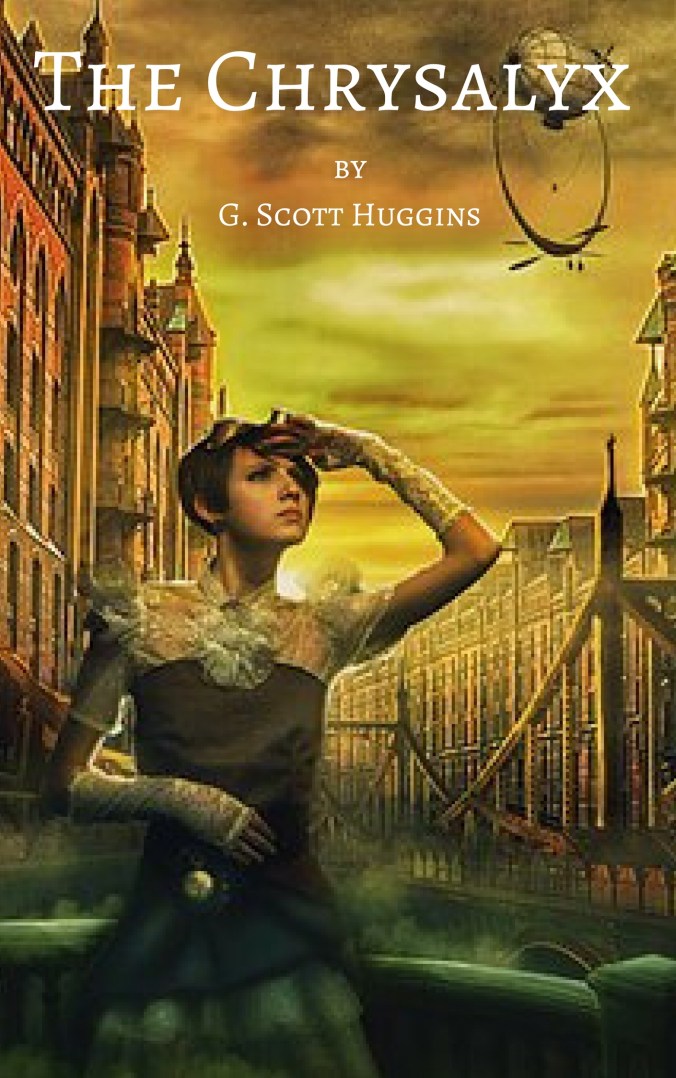
This is one of the major reasons for the hiatus of last week. I was preparing to launch my latest venue. If you are up for supporting me for $1 on Patreon, you get first crack at my steampunk alternate-history novelette, “The Chrysalyx” in .mobi (Kindle) format. This novelette will revert to the Secret Story Vault ($30 tier) in April.

In a world where dreams can shape flesh, and the British and German Empires maintain an uneasy peace with the Confederate States, Special Agent Aemelia Stapledon and Jupiter Breckenridge of the President’s Guard must discover the limits of the transhuman and their own capabilities if they are to stop a plot to re-image humanity into its darkest nightmares. Their hunt will lead them to the highest levels of power, and to the unfathomed depths of The Chrysalyx.

Words: Stranger Things 2, Episode 9 Microblog (Much Spoilers, Etc.)

The Good: An awesome ending to an awesome show. I’m really not sure what to say about it that wasn’t great. In some ways, it reminded me of The Lord Of The Rings, with El and Hopper going into the Gate to seal it while the rest of the gang takes on the role of Aragorn and company by distracting the evil forces with various forms of fire. And unlike the previous season, we are not left with much of a cliffhanger.

The Bad: If you haven’t figured it out by now, I’m a natural quibbler, so before reading this, understand that none of this makes the show less than good. It irritated me from the start that no one tried heat on Will before this. As Joyce says, why were they giving it what it wanted for so long? Also, I wish the tension between Max and El had been more resolved in a more concrete fashion. That just felt as though it was left hanging.
One thing I meant to say in a previous post and forgot to, about Max and her douchebag older brother:

The tension that had been building around their origin and appearance was both weirdly heightened and killed by the appearance of their parents. Brother’s father had the weird effect of making me want to cheer him on by smacking around his son who desperately needed a smacking around, but also to want to shoot him because the odds are that he’s the reason his son is such a douche in the first place. We still don’t know exactly why Brother blames Max for the move from California, and until seeing the parents arrive, I thought these two were actually on their own. I leave it to the writers to wind this up in Season 3, but for now it feels flat.

And oh, gods, please PLEASE don’t really drag us through the stomach-twisting awfulness of an affair between douchey Brother and Mike and Nancy’s mom. Just barf.

Further Questions: Is Brenner alive? How and what is he doing? Obviously, the Thing in the Upside Down s still very much alive and wanting to get back to our world. Can it without some sort of assistance? We’ve met Eleven and Eight, which means there are potentially at least nine other Gifted we could encounter. Will we ever?
And is Steve really okay with where things ended up, or is he plotting something in that mind of his…

Final Thoughts: I’d really love to have some more indication on what the real nature of the Upside Down is. So far, the whole thing really has read as if it were D&D come to life, which is cute, but ridiculous. I keep wanting  better explanation, such as that it is an alternate timeline where Something Bad Came To Earth. I just find it hard to believe in a universe where things are built by no one and are always decayed.
In the course of this blog, I have seen a bit of fan speculation that Mike may be (or should be) killed off. I hope not. I think that would be the absolute wrong move. It would feel like a very artificial way to torture El and make her less human. The love story between El and Mike, and its innocence, is the heart and soul of this story. To delay it is certainly legitimate: it has to be laid on the line to make it worth something. To destroy it is to destroy the work.

Words: Stranger Things 2, Episode 8 Microblog (Much Spoilers, Etc.)

The Good: I really love what they did with Bob’s character in this episode. Here’s a man who has every reason to run from the strange situation he’s been thrust into, to refuse to believe what’s going on, and yet he sticks with it every step of the way. He steps forward to place himself in mortal danger not because he wants to prove himself, but because he knows he’s the only one who can do what needs to be done: resetting the computer system. One of my favorite lines in the series has to be: “Well, teach me BASIC.” “Oh, sure Sheriff. How about I teach you German to go with that. Or French; would you like to learn French?” Likewise, Paul Reiser’s character lays it on the line, becoming a true leader. These guys are men. Real men, who do what real men ought to do.
I love — more than I can say — the fact they did something with the creature’s mind control of Will that is so rarely well done: giving him agency down to the very last, figuring out how to send the coded message to his friends. That kicked ass, being very well-established and reasonable.
And finally, there was the return of El, which was everything it should have been.
The Bad: I really hate what they did with Bob’s character in this episode. First of all, the whole “Somehow, he forgot his gun in the control room” thing was just stupid. Especially given that how he died, that gun would have been 100% useless. It was incredibly predictable that Bob would die, which is the major reason I wish they had not killed him off. Frankly, it felt like they did that just to make Joyce more miserable, and I am really tired of seeing Joyce miserable. It is taking a character who is in many ways admirable, if understandably overbearing and needy (who wouldn’t be?) and hammering her flat by never allowing her a single moment of relief from loss.
Further Questions: How will El close the Gate? And how many more will we lose? And please, please, please, don’t kill El for reals this time.

The Word: The God Of Large And Small

Another theology column that I originally wrote for Sci-Phi Journal.

In his short story, “The Theologian’s Nightmare,” (Fact and Fiction 1961) the philosopher, astronomer and atheist Bertrand Russell presents the absurd tale of Dr. Thaddeus, who dreams himself into a Heaven staffed with great alien minds who have never heard of the “parasites” called man, who infest the planets of an ordinary star in a commonplace galaxy. They are mildly amused that one of these parasites suffers the delusion that its race is the acme of creation.

I cannot help admiring Dr. Russell’s intelligence, or his elegant skewering of the ego of humankind. In fact, as a Christian I have to admit that (especially) our overinflated egos have often deserved such skewering. That sentiment is hardly out of place in the Bible. Indeed, one might say it is the entire point of God’s speech in the Book of Job. And yet, as an attempt to show the absurdity of humanity’s desire for a connection with its Creator, I have to wonder at the failure of imagination that posits a God too big to care for Its creation. Humanity as such is simply beneath Its notice. It is like Clarke’s Overmind, which I discussed in my last column. Like Russell’s, Clarke’s evolving god is too big to love (in fact, it is implied that it must be), too big to be grateful. It is a monstrous Beyond Good And Evil that eats its children like Saturn, so that it may be increased and glorified.

But an astronomer and a philosopher of all people should be well aware that size itself is no argument for complexity, let alone wonder. And while it makes perfect sense that the love of a god (let alone the love of God) might be incomprehensibly more than we can ever imagine, and might at times be strikingly – even shockingly – alien in its highest expressions, surely it can never be less. That strikes at the root of all human experience and all logic. Surely, that which is more includes that which is less. It does not exclude it. A baby can understand love only in that it is snuggled and is dry and is fed. It knows nothing of a love poem or heroic deeds in the name of love. It would find them alien and possibly even frightening if it were give them. But as an adult, I can still enjoy being snuggled and being fed, and I can certainly understand how to give these things to my children.

One of my favorite authors, who understands this beautifully, is Lois McMaster Bujold, who is the best since Dan Simmons (and perhaps C.S. Lewis) at conveying a God who is both big enough to create worlds, and small enough to love those who inhabit them. Her land of Chalion and its Five Gods is astonishingly well realized. Through her protagonists, Cazaril and Ista, Bujold draws for us broken and real humans, who abandon their gods, curse their gods, and suffer greatly. And like those of us who choose to follow our God, these men and women are faced with a terrible choice: to keep faith and do what is right when the cost seems disastrous, or to run away and save themselves. Bujold’s gods cannot compel their humans (just as, I would argue, God cannot compel a free choice, but that is beyond the scope of this piece) and the cost of that free will hurts Ista terribly. In Paladin of Souls, brought face-to-face with the god called the Bastard she cries: “Where were the gods the night Teidez [her son] died?” He answers:
“The Son of Autumn dispatched many men in answer to your prayers, sweet Ista. They turned aside upon their roads, and did not arrive. For He could not bend their wills, nor their steps. And so they scattered to the winds as leaves do.”
Bujold portrays gods who yearn for their children to arrive home safely at the end of their lives, and are heartsick at each soul that is lost:
“The Father of Winter favored her with a grave nod. ‘What parents would not wait as anxiously by their door, looking again and again up the road, when their child was due home from a long and dangerous journey? You have waited by that door yourself, both fruitfully and in vain. Multiply that anguish by ten thousands and pity me, sweet Ista. For my great-souled child is very late, and lost upon his road.”

But at the same time that she understands God’s love for His children, she also understands the fearful demand of the duty God lays on us to one another. Even better than she does in the Chalion books, Bujold portrays this in her science-fiction novel Falling Free, when engineer Leo Graf is thrust into the position of the only man who is willing and able to save the quaddies – children who, being genetically engineered to work in space, have two extra arms in place of their legs – from a Company that no longer needs them, and plans to have them quietly euthanized. When his supervisor washes his hands of the problem, saying he has done all one man can do to save the quaddies in the face of the company’s power, Leo also faces the choice, and grasps its full import:
“’I’m not sure… what one human being can do. I’ve never pushed myself to the limit. I thought I had, but I realize now I hadn’t. My self-tests were always carefully non-destructive.’ This test was a higher order of magnitude altogether. This Tester, perhaps, scorned the merely humanly possible. Leo tried to remember how long it had been since he’d prayed, or even believed. Never, he decided, like this. He’d never
needed like this before…”

The challenge that any attempt to criticize God must meet, and that so many of them fail to grasp, is a full understanding of the scope and power of an omnipotent God. It must understand that the same God that is credited with designing the galactic voids and the superclusters is also the God of gluons and quarks. That the same God who arranged for the long dance of evolution can care just as much about the dance of a father with his daughter at her wedding. This does not mean that we deny that terrible things happen: they do. We, the creation, have much to do with whether or not they happen. What it does mean is that we are obligated to understand that God is big enough to be there at the end of the roads of galaxies, and that He is small enough to open the door for a single human.