The Awful Choices

This one’s going to be fast, because I’m running out of time, but it’s one I hope is useful to other writers.

Recently I was reworking a story because of length issues. Amazingly, it was because the story was too SHORT for a market by about 3,000 words, and if you don’t know how rare that is, then oh, my sweet summer child. As I worked on it, I realized that I had made a blithe assumption about how possible it was to do something involving helicopters.

So I consulted an expert and simultaneously realized that a) there were two really obvious workarounds if “something” turned out to be impossible. As it turned out, the expert got back to me and told me that “something” was quite workable so long as you did, in fact, have really GOOD helicopter pilots.

So now I had three possible ways of solving my problem, but the following issues:

Most Dramatic/Awesome Approach (i.e. “something”) is also Least Plausible Approach.

Least Dramatic/Awesome Approach is also Most Plausible.

Most Plausible Approach also is Most Likely To Surprise Protagonists (which needs to happen).

Middling/Plausible Approach makes it difficult for the protagonists to ever find out what happened.

I turned to my research to see if it could nudge me along the right track, here. No such luck. The research basically said you could do whatever and justify it from there. So what should I do?

I still don;t know. But I’ll tell you what I’m going to do. I’m going with the high action/drama, because that shit is FUN, and why the hell else do people read science-fiction?


Unanswerable Questions: What Would A Space Battle Really Be Like?

Years ago I was asked one of those questions that is fascinating. I was sitting at home with my flatmate (this was before I was married) and he asked me, “So what would a space battle really be like?”

And the problem is that, after pondering it, I had to conclude that the question was basically unanswerable.

I’m bringing it up because, as we all know, the Internets have no shortage of self-proclaimed experts willing to defend their vision of space-battles to the teeth. Often, they have very good arguments, because they’ve been thinking about this a long time. Sometimes too long. And they will rip into anyone, fan or writer, for not agreeing with them. But almost always, their superiority rests on a certain set of assumptions. Within those assumptions, they are very often right. But the assumptions have to be identified.

The first assumption that has to be addressed is the general level of technology you are fighting with. What is your power source? Your space drive? What weapons are available? What defenses? The beam weapon, the force shield, and the reactionless drive are all SF commonplaces. But they don’t always exist together. Which ones do, their power, and in what combination they exist all inform what a space-battle would look like.

A very well-realized universe for this is David Weber’s Honor Harrington series. With gravitic drives that protect ships absolutely from above and below, lesser shields (sidewalls) that protect them on the flanks, and vulnerable bows and sterns, his starfleets can resemble old Naploeonic-style sailing fleets. Cheap fusion power and antiacceleration fields enable the ships to accelerate at hundreds of gravities, and to launch missiles for long-range combat and use fixed-mount beam weapons at shorter ranges. Once you buy into all those givens, you have a system of “real” space combat.

But even once we’ve agreed on the technology, it would be difficult to answer the question. I mean, we might ask, “What would space combat look like with present-day technology?” That’s a better question, but then you have to ask a few more. Do you mean right now? That’s easy. It looks like robotic or remote-operated killer satellites trying to take out enemy recon satellites and stopping them from doing the same to us. Or do you mean, “What could we build right now if we really wanted to?” Because now you have to start asking questions like, “What’s the mission?” “How long do we have until we have to use it?” And, “Who are we fighting?”

It should be obvious that the answers to those questions will very much determine the answer to the original question. If the object is to invade or destroy a nation on Earth, then an offensive spacecraft would pretty much need to look like a bomber, ready to rain death on the planet, perhaps with defensive measures against nuclear-tipped missiles. How big the bomber would be would depend on how long we expected to need it. In a sense, an ICBM is a one-use, robotic version of this. Since we expect the enemy nation to be destroyed by using them, we don’t need them more than once.

Obviously, if the mission differs, so will the spacecraft, and so will the battle. If we need to shoot down an enemy space platform, what will we need? Missiles? Or actual space fighters? Or do we want to capture it, necessitating boarding equipment and tactics? What if we want to defend the planet against an unknown threat? Should we develop fighters? A fighter carrier? Or a really big battleship? Or what if we want to send a ship to mine the asteroids and we suspect someone would like to prevent that? Or capture the ship on its way back when its hold is full of valuable metal?

Our navies on Earth have a variety of ships to do a variety of jobs, form surface cruisers, to submarines, to aircraft carriers and a host of others. What a “sea battle” — or for that matter, a “land battle” “really” looks like depends very much on what forces are involved in accomplishing what objectives against what opposition. Space combat will, too.

Pure Energy

I’ve been thinking lately about why science-fiction seems to be very enamored with the Gnosticist flavor of mind-body duality. Star Trek and Star Wars popularized an idea that seems to have been old since at least Childhood’s End in science-fiction, and was an old religious idea millennia before that: that the truly advanced beings will be “pure energy.” Bodiless souls immune to the corruptions of the flesh, which will transcend evil (and perhaps good) and go on to heights of intellect that we poor meatsacks can hardly imagine.

I suppose it isn’t much of a mystery where this comes from. After all, it is our bodies that  usually die and get hurt before our minds. It is our bodies that hunger, thirst, and age. It’s tempting to believe that without them, without the constant need to care for them, that we could be so much more.

And yet, the whole idea smacks of the same kind of naive folly that leads Terry Pratchett’s Leonard da Quirm to conclude that humans granted the power of flight would transcend war and crime because they would no longer be limited by geographical boundaries. With the power of flight over a hundred years old, we can see the ridiculousness of that claim. But it’s harder to imagine what beings of pure energy would be like, and what crimes they might commit.

The interesting thing is that these energy beings aren’t usually portrayed as terribly morally good, just… advanced. And “advanced” always seems to mean more powerful, and seldom “better.” Perhaps a good analogy might simply lie in the classism that we often see in our own cultures that assumes that rich people who work — or steal — with their minds are better than poor men who must make do with their muscles. As below, so above. We see muscle without guiding minds about us all the time in the bodies of animals, and assume that the opposite — guiding minds without bodies — must be superior. The equally possible conclusion, that such an extreme might be as damaging to us as the animal state, does not seem to occur to us.

Why is it so hard for us to see that Dorothy Sayers called it rightly when she suggested that the calling of a manual laborer to do his work honestly and well is just as important as that of a clergyman to serve with integrity and piety? Is it simply because we cannot conceive of a moral duty without moralism? With a moral sophistication that has nothing to do with a physical sophistication?

If so, it is a failure of imagination, and not its manifestation.

Writing Roundup 2018: The Bad, The Good, and The Beautiful

Well, for the last blog entry of the year, it’s time for 2018’s Writing Roundup. I’ll start with the bad news.

2018 was my worst year for short story sales since 2014. I was only able to sell two stories to new markets, though I am proud of both sales. “Iron Out Of Vulcan,” about a strange apocalypse that spared only the disabled, appeared in the anthology Battling In All Her Finery, and “In The Republic Of The Blind,” a military Space Opera originally written for (of all things) an anthology on Space Marine Midwives (which as far as I know never launched) sold to Amazing Stories. Of course, it is always nice to crack a new pro magazine market, so that is the silver lining.

However, 2018 was also my best year for actually writing, possibly in my life. The first part of the year was taken up by receiving my very first novel contract, which takes a bit of the sting out of the aforementioned short fiction sales slump, from Digital Fiction Pub, for a 53,000-word middle-grade science-fiction adventure on the moon with the tentative title of The Girl Who Wasn’t There. This should be released in 2019.
The next major project that I tackled was the rewriting (at the request of a Publisher-Who-Cannot-Be-Named) of a manuscript I had previously submitted, tentatively titled Beneath The Verdant Tide.
And finally, I finished the draft of the full novel-length version of A Doctor To Dragons, which is tentatively titled All Things Huge and Hideous. I hope to have this released in early 2019, but if you want an early look, the chapters are being released each month to my Patreon backers.

My first novel manuscript took me five years to finish. This year I knocked out two while revising a third, so I’d say that this represents a major leap forward in my production, including the discovery of the fact that I am indeed capable of writing a novel LESS than 125,000 words in length.

All in all, a good year, and I can’t wait for the next one. I hope all my readers feel the same. May the New Year bring you all the best.

Scott Huggins

A Modest Proposal: The Bombadil Scale of Sidequests

A friend recently asked in a open forum what the proper size of a sidequest in a novel should be. We all know sidequests: those are the moments in which the characters pause in the middle of their Main Quest to do Something Else. What the Something Else may be has a huge (but not the only) effect on its proper size. This got me thinking, and I would like to propose the following system of measurement:

The SI unit of measure for a sidequest is the bombadil. One bombadil is the amount of gratuitous sidequest necessary to make 50% of readers give up on their first readthrough. No sidequest should ever measure more than 0.05 bombadils, though famous authors may push it to 0.1 bombadil.

The amount of prose necessary to comprise a bombadil is variable, and depends on the general tediousness of the sidequest, the characters involved in the sidequest, how much they grow in the sidequest, and how it affects the progress of the Main Quest. Of course, it also depends on the raw length of the sidequest, but that is not as important as you might think. A truly gifted writer can make the sidequest just as important as the Main Quest.

So let’s look at the archetypal case. In The Fellowship Of The Ring, our heroes, Frodo, Sam, Merry, and Pippin, all get ensorcelled by an evil tree and freed by Tom Bombadil, a mysterious humanoid who takes them home to his just-as-strange wife for dinner. Bombadil later frees them from an evil barrow-wight and arms them with the treasure it was guarding. Breaking it down we have:

T = general Tediousness: Very High. The characters eat and sleep and listen to childish lyric poetry (10), slightly offset by them getting into two spots of serious and interesting trouble (-2): 8
S = characters exclusive to the Sidequest: 2 (lowest value for this variable is 1)
M = characters on the Main Quest: 4
g = growth of the characters because of the sidequest: Significant, but small. Frodo shows that he is capable of thinking, fighting and securing a temporary victory at need: 4
D = What it Diverts from: Walking to the nearest town. This is difficult, because on the one hand, diverting us from something that should be skipped right over adds tedium, but diverting us in the middle of something absolutely critical to the main plotline is worse, so this defies an easy, linear scale. Allow negative numbers on this one, with zero being the value at which the plot is progressing at a steady, unhurried, pace: Just walking along: -2
Finally, we introduce 4 as a constant, because all great equations have constants, and because a sidequest is only about a quarter as interesting as the main quest at best, a fact writers should ALWAYS remember, regardless of how clever they find themselves.

This gives us the following equation:

TSD²/4Mg = Qs (Sidequest value in bombadils)

And plugging in our values, we get:

8*2*2²/4*4*4 = 1 bombadil.

Initially, I had been going to factor in the sidequest’s ultimate importance to the story, whch would have made the score lower because one of the hobbit’s weapons, acquired on this sidequest, ultimately helps to destroy the Lord of the Nazgul. But the point is that we do not know that, and therefore it has no effect on whether or not the reader gets bored to death and puts the book down.

So, for some examples:

The Empire Strikes Back: Luke’s training sequence on Dagobah: Qs = 0.05 bombadil
T = 5 (cool Jedi powers and a fight with ghost-Vader, offset by boring platitudes on Planet Swamp).
S = 1
D = 0.5 (an increasingly-tense hunt for the Falcon, but Luke has to have a storyline of his own)
M = 1 (no, Artoo doesn’t count)
g = 6 (Luke becomes at least half a Jedi, but undisciplined.

The Eye Of The World: Perrin and Egwene’s sojourn with Elyas: Qs = 0.25 bombadils
T = 4 (It’s Jordan’s incredibly-detailed prose, but the whole thing with the wolves is awesome)
S = 1 (Elyas)
D = 1 (It’s about on pace with everything else)
M = 2 (Perrin and Egwene)
g = 8 (This sidequest basically starts Perrin’s character arc as a badass)

Moby Dick: The chapter on whales: Qs = 36 bombadils 
T = 9. A lecture on whales. In the middle of a novel. Only not a 10 because whales are inherently cool.
S = 1
D = -2 (for being Moby Dick. They’re sailing.)
M = 1 (Ishmael)
g = 1 (he learns about whales)

It: That one scene near the end as the kids escape the recently-defeated It. Yeah. THAT one: Qs = 96 bombadils
T = (the exact number defies description, but the Ick factor makes me conservatively estimate it, on a scale of 1 to 10 at) 27.
S = 1
D = 5 (seriously, the book was OVER).
M = 7
g = 1 (in a really disgusting way)

Note that when main characters are uninvolved in the sidequest, you are approaching infinite bombadils, and should just stop.

So, there you have it, a completely objective and indisputable method for solving the worth of various sidequests. You’re welcome.
 

Release Day: Iron Out Of Vulcan!

Today, my story “Iron Out Of Vulcan” releases in the anthology Battling In All Her Finery from Mad Scientist Journal! Accompanied by twenty other tales of awesome warrior women (and who doesn’t like those), it is a tale of post-alien conquest apocalyptic survival. Short version, of you liked Furiosa, you’ll love Scout.

And just for your enjoyment: an excerpt:
I rode between two drum-fed National Guard .50 caliber machine guns mounted in a plexiglass ball-turret, mounted on the back of a microbus shell welded over the bed of the six-wheel Ford F550. Again, I peered through the iron crosshairs at the black speck in the distance.

Definitely a motorcycle.

“We have a friend,” I called through to the cabin. “Watch for IEDs.”

“Oh, sure; I’m on it,” Mina deadpanned. But she signed to Eric, which was good enough. Paul moved forward, too. It was a standard trick. Make your target watch you, and they might miss your roadside bombs. Best way to take us out, unless they had spike-strips.

“Who is it, Scout?” asked Mina. “Not Them, I take it?”

“She’d be swearing more,” Eric grunted.

“I don’t know,” I said. Not Them. A gang out of Chicago or Dallas, maybe. The remnant of a Mexican drug cartel, perhaps. The bandidos had tried taking Criptown from us last summer. Cost us a lot of good Crips and ammo we couldn’t spare.

Some thought we shouldn’t call the place ‘Criptown.’ Worried it might scare potential recruits off because of the old gang name. As if any of them had got out of the cities before the nukes hit.

I looked back at the cycle. We could only hope that cycle-boy’s friends would decide Vulcans weren’t worth the carnage.

I looked at the empty road ahead. Somewhere out there, a radio had called for us. Was it a trap? Some Vulcans had disappeared. Maybe this cyclist’s friends had set us up. Or maybe someone else had. Or maybe – just maybe – the signal was genuine. It was a chance we would have to take, if we could find them.

We needed people desperate enough to live free.

Return To Amazing Stories!

I just realized that I never followed up on the post from June about my story about Space Marine Midwives (In Space).

It has been sold to Amazing Stories, and will appear in the next issue releasing mid-November. I was in the second-to-last issue of Amazing Stories when it folded in 2000, so I find the symmetry especially pleasing to find myself in the second issue of its next incarnation.

The story that will appear is called “In The Republic Of The Blind,” and is a twist on H.G. Wells’s better-known work set on a long-forgotten colony where the formerly disabled preserve their own cultures.

You Can Always Get What You Want… But First You Have To Figure Out What You Need. OR: Yes, You Can Have Your Space Fighters Dogfighting In Space.

One of the things that truly sucks about Fans of Anything is that they all have their ideas about what constitutes “Anything.” It’s not a soluble problem: without passion, you don’t have fans at all, and with passionate love of what they like comes equally passionate hatred for what they don’t like.

Science-fiction fans, especially the book-reading ones (yes, there are non-book reading ones… sort of… shudder) really love to bag on movies for getting space combat “wrong.” Just to take some examples not at random: 1) you would not be able to see beam weapons in space. 2) Human reflexes would be almost useless in space combat because computers would fight so much faster. 3) Weapons would strike from so far away that enemy ships would be invisible to the eye, and 4) Therefore dogfighting starfighters are stupid.

And let’s admit one thing right off. If you’re writing super-hard SF, and restricting yourself to tech we can build today or are planning to build tomorrow (see Niven and Pournelle’s Footfall for an epic space-battle scene of that type) then you’re pretty much right on all counts.

But the problem is that the same things are said of works that utilize gravity drives, hyperspace, force shields and any number of other things that move the fiction completely into the Space Opera subgenre. To which I reply: are you KIDDING me?

Look, folks, you can’t have hard science-fiction and space opera at the same time. You can sure as hell enjoy both: I do. But if you’re going to complain about spacecraft maneuvering like airplanes and ships hitting each other from visible ranges, then let’s be honest and complain about EVERYTHING. Let’s have no warp drives, no magic shields, no acceleration compensator fields, no antigravs, nothing.

And for cripes’ sake let’s not pretend that space opera is worse LITERATURE. One of the finest works of SF Literature in history is Dune. The novel that decided that guns would be obsolete because of personal body shields that would bring back a form of feudalism, and as a side note wiped out computers because of a religious war. Or we could look at The Left Hand Of Darkness that posits a branch of humanity that have evolved a sexual mechanism that hasn’t been seen in any known species more advanced than… what? Frogs?

No, if you want to make your Space Opera work, then make it work. Just don’t be stupid about it. I can outline a way to make manual starfighter combat plausible right now. It involves a lot of handwavium, but it’s not hard.

Imagine for a moment that humanity has developed the (what could I call it?) the Yamamoto Field. The Field’s generator can be carried by a fighter-sized craft. The Field has the following qualities:

1) It’s impenetrable to E-M radiation except for visible light. Any other form of radiation is absorbed or passes through is refracted around it. Its radius when activated is at least a half-mile.

2) The Field also prevents computers and other delicate electronics from functioning inside it. It scrambles their circuits. Only simple mechanical calculation devices can aid the human pilots.

3) The Field deflects incoming objects directly proportional to their velocity and inversely proportional to their mass.

So, now I have a Field that’s going to protect our fighters from targeting computers, guided missiles, and high-velocity mass-drivers. It provides no protection from lasers, but you’re going to have to fire those pretty much with the Mark I Eyeball assisted with passive lenses. Since the Field can also be mounted on capital ships, they will have much the same problems. Granted, nuclear weapons might be brought in to solve those problems, but larger Fields might nullify that threat.

Now, it’s possible that I overlooked something in the design of the Yamamoto Field. It’s possible that one of my commenters will gleefully point it out to me. But I trust the point is made: a piece of tech COULD be plausibly designed to bring back WWII Fighters In Space. You might not like that story. You might not want to read that story. Which is fine; there are poor lost souls out there who don’t like Dune.

But it doesn’t mean it can’t be a good story.


Science Fiction Pet Peeve: Really Bad Naval Architecture.

Okay, it’s time to discuss one of my favorite topics: Pet Peeves Of Science-Fiction. In this edition, we’ll discuss really awful naval architecture.
Naval architecture is, of course, the science and art of designing warships. Now, for most of history, warships were really just floating fighting platforms that rammed into each other, after which the soldiers aboard tried to kill one another in various awful ways. With the advent of guns, people had to decide where to put them, and the physics of sailing pretty much meant that the guns, which were very small compared to the ship, had to be placed in broadsides, like so:
Related image

However, with the advent of better steel and larger guns, cannon could be built that were a significant fraction of the ship’s width, and launch shells that would gain a lot from being able to elevate the guns significantly. Additionally, these guns were too heavy to permit the ship to carry twice as many of them that would be permanently pointed away from the ship. With the simultaneous elimination of sail, that meant that guns could and should be placed in turrets with about 270 degrees of action, thus:

Image result for uss new jersey deck plans

Of course, 360 degrees of action would have been better, but you have to have a place for the bridge, the smokestacks, and of course, the OTHER GUNS to be, safely.

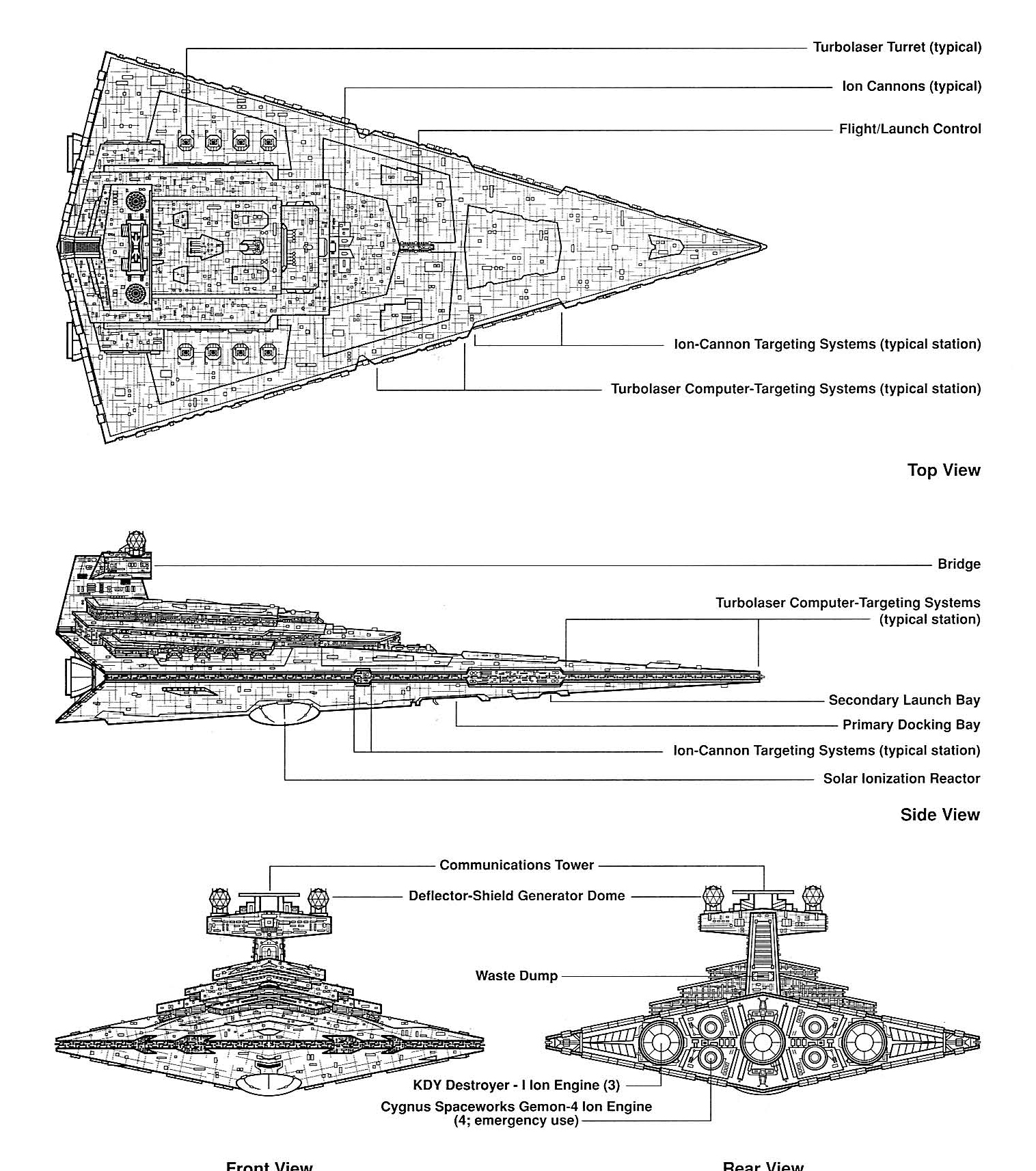
Okay, so that’s basic fields of fire as influenced by technology. Okay, ready? THIS is an Imperial Star Destroyer:

Related image

Take a good look at the turbolaser batteries. They are arranged in broadsides, and they are tiny compared to the ship, and most ridiculously, they are in turrets.

Now, the fact that they are tiny is not a problem. We know from Star Wars canon (no pun intended) that these are very powerful ships. It may be that Star Wars ships HAVE to be that much bigger than the weapons they carry simply to power them, and that most of that mass IS power generation.

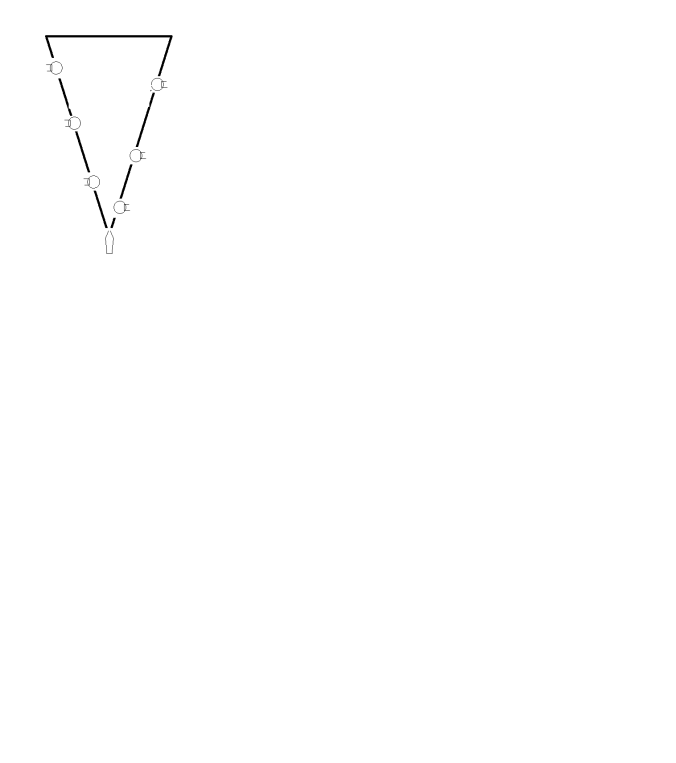
But they are arranged in broadsides, and only half of them can fire at a given moment because of the superstructure. Which begs the question: was there any reason these guns couldn’t have been put on the BOTTOM of the ship? They can’t even fire forward or aft except at half-strength, because the guns block each other. For a simplified version, they look like this (please forgive the ridiculously poor computer drawing skills):

ISD 1

Now in space, there’s no excuse for this., especially when we know that the Star Wars universe has the technology to make very fast and maneuverable turrets. The only way this makes sense at all is if a Star Destroyer can roll and pitch so fast that turrets don;t really matter at all, and we know from the events of pretty much all Star Wars movies that this is not the case.

A far superior design would be this:

ISD 2.png

From this design, we can immediately see that I don’t know how to manipulate images very well, but we can ALSO see (and this is my point) that with larger, globular turrets that could clear the entire hull, a Star Destroyer design could easily have been imagined that would have allowed all turrets to bear on targets both above and below and (assuming, again, large turrets and a FLAT hull), to fore and aft, and even to both sides simultaneously by offsetting them as pictured. The bridge (assuming it could not have been buried deep in the hull, which is where it always SHOULD have been) could be moved up front.

Why isn’t this done? Well, I suspect that for one thing, people tend to find asymmetry ugly, even when it is practical. And for another, Lucas seems to have really liked the idea of big ships with tiny guns, possibly to justify his overreliance on space fighters (about which more another time). But it just annoys me when people build ships that, for no apparent reason, have huge unnecessary blind spots. When we build the ships of the future, they should at least be well-built.