Pure Energy

I’ve been thinking lately about why science-fiction seems to be very enamored with the Gnosticist flavor of mind-body duality. Star Trek and Star Wars popularized an idea that seems to have been old since at least Childhood’s End in science-fiction, and was an old religious idea millennia before that: that the truly advanced beings will be “pure energy.” Bodiless souls immune to the corruptions of the flesh, which will transcend evil (and perhaps good) and go on to heights of intellect that we poor meatsacks can hardly imagine.

I suppose it isn’t much of a mystery where this comes from. After all, it is our bodies that  usually die and get hurt before our minds. It is our bodies that hunger, thirst, and age. It’s tempting to believe that without them, without the constant need to care for them, that we could be so much more.

And yet, the whole idea smacks of the same kind of naive folly that leads Terry Pratchett’s Leonard da Quirm to conclude that humans granted the power of flight would transcend war and crime because they would no longer be limited by geographical boundaries. With the power of flight over a hundred years old, we can see the ridiculousness of that claim. But it’s harder to imagine what beings of pure energy would be like, and what crimes they might commit.

The interesting thing is that these energy beings aren’t usually portrayed as terribly morally good, just… advanced. And “advanced” always seems to mean more powerful, and seldom “better.” Perhaps a good analogy might simply lie in the classism that we often see in our own cultures that assumes that rich people who work — or steal — with their minds are better than poor men who must make do with their muscles. As below, so above. We see muscle without guiding minds about us all the time in the bodies of animals, and assume that the opposite — guiding minds without bodies — must be superior. The equally possible conclusion, that such an extreme might be as damaging to us as the animal state, does not seem to occur to us.

Why is it so hard for us to see that Dorothy Sayers called it rightly when she suggested that the calling of a manual laborer to do his work honestly and well is just as important as that of a clergyman to serve with integrity and piety? Is it simply because we cannot conceive of a moral duty without moralism? With a moral sophistication that has nothing to do with a physical sophistication?

If so, it is a failure of imagination, and not its manifestation.

Black Panther And Infinity War: Choosing Who Dies On Your Hills.

So, to continue my earlier post on Black Panther, I just really want to know what the MCU was thinking when they allowed Black Panther to die as a result of Thanos’s snap.

And here, I’m not talking about the insensitivity toward a whole lot of Black fans felt by MCU making that move. That’s been discussed, in depth, by Steven Barnes and a whole lot of other people better qualified than me to do it, so I’m not bothering to recap it here. Put simply, it was really bad writing that took a dump on a franchise that MCU had obviously tried to elevate.

I mean, in a sense, Avengers: Infinity War really wrote itself into a corner. Thanos is essentially Sauron, trying to get his hands on a six-part One Ring that makes him invincible. The idea that Frodo has to win by first allowing Sauron to succeed is really fascinating. But they have Wakanda playing the role of Minas Tirith, and losing the Battle of the Pelennor Fields. But killing off all of Wakanda’s men, save M’Baku, was really foolish. Firstly, you never alienate an entire franchise’s fanbase. That’s just bad marketing.

Secondly, it really doesn’t matter that T’Challa et al. are coming back. Because now, they can never really be the ultimate heroes. They will always be the ones who had to be rescued by the real heroes. And it doesn’t matter that it was random, or that it was unfair. It’s unfair in sports when, say, a wide receiver misses a catch in the end-zone under double coverage that would have been almost impossible to catch, and then a kicker who makes a 25-yard field goal is hailed as the hero for winning the game. The kicker’s job was MUCH easier. But in sports and war that’s just the kind of unforgiving valorization of results that we have to have. In the end, victory is all that really matters, and anyone who’s ever played a game knows that this is so.

In the end, it’s just bad writing to set up characters to be the kind of heroes that Black Panther’s characters were set up to be and then kill off the main hero. It would have been far better to leave T’Challa alive and the king of nothing. Then he can redeem his failure by resurrecting the nation. And it’s not really fair either to point out that other franchises lost their heroes, too, even though it’s true that they did. Peter Quill died, yes, but in some ways, Thanos’s victory was his fault for spoiling the Removal Of The Gauntlet, so he had it coming. Spiderman died, but compared to the rest of the Avengers, he was a kid, hardly expected to pull his own weight. Only T’Challa was a king.

The only way I can see for MCU to come close to redeeming this is for the defeated characters to somehow be brought back prior to Thanos’s defeat, and being absolutely key to that defeat. In other words, for T’Challa et al. to rescue the survivors of Infinity War right back.

Black Panther, The Oscars, and the Writing of Really Great Superhero Movies

So, Black Panther was nominated for seven Oscars, including Best Picture, and I’ll be the first (actually, the millionth) to say that it deserves the nomination, at least as much as Star Wars did in 1978. Whether it wins or not, it’s a stunning film.

I’m going to preface this with a note: I’m pretty sure that I will never feel, on a gut level, how important Black Panther was to Black Americans. My Black friends who care about such things are absolutely in love with the movie, and I suspect, were I Black, I would be, too, and for a host of reasons I can only partially fathom. I think it is an awesome movie.

And yet… somehow, for me, it doesn’t quite measure up to the very best of the best movies in the superhero genre, and it took me awhile to figure out why. There was just something about it that kept me from putting it on the same level as Captain America: Civil War and The Incredibles. Because these are the superhero movies I watch again and again.

I finally figured it out a couple of days ago, and when I did it hit me like a freight train, because I’ve seen the exact same flaw in my own work, and in other unpublished novels. The problem is that it’s hard to explain. The best way I can say it is this: when you are working with complex characters, it is often very tempting to put them on the stage alone, or with only one other character. Doing so allows you to make the audience focus on them. In addition, it is VERY tempting to make especially your villains into ultimate badasses. After all, the more powerful they are, the more glorious your hero’s victory over them.

Black Panther does this with Erik Killmonger. Killmonger arrives, having killed his former partner, Ulysses Klaue — which T’Challa could not do* — and leverages this into a bid for the Wakandan throne, revealing his identity as an abandoned Wakandan prince of the blood.

But unfortunately, this screws with the film in two other ways. Firstly, it forces the film into a scene that is almost purely repetitive. We have to go through the entire “duel for the throne” that T’Challa just won against the Jabari challenger. It forces us to tread over ground already covered. Secondly, it throws the whole Wakandan throne — or T’Challa’s judgment — into question. If the throne is permanently open to challenge, then how stable can it be? It can’t and the film implies that T’Challa, already having gone through the challenge, would have been well within his rights to refuse the challenge. But he accepts, in what I consider to be the weakest part of the film. It actually makes T’Challa less of a hero, because he places Wakanda at risk of being taken over by a monarch who will have absolute power, who has shown the willingness and potential to brutally destabilize the world, and who has no reason, really, to keep Wakanda safe: Killmonger pretty much blames Wakandan inaction not only for his own terrible life, but for the unopposed colonialism and conquest of the developing world. Why does T’Challa do this? Because of guilt at his father’s action? Because he believes he can’t be defeated? Neither is a good reason.

With the admitted benefits of hindsight, I think that there were ways to avoid this. For example: Suppose the coronation itself is interrupted by the need to apprehend Klaue and the stolen vibranium. T’Challa points out that a true king must prioritize the defense of the nation over his official coronation. Then, while having the wounded Ross airlifted out by Okoye and Nakia, he chases down Klaue and Killmonger. Killmonger shoots Klaue in the back, and then proceeds to fight T’Challa and lose. Upon surrendering, he is taken into custody.

Back in Wakanda, Killmonger asks only one favor for his plea of guilt: he asks, as a descendant of the African Diaspora, to witness the Wakandan coronation ceremony. T’Challa accedes to this harmless request. At the coronation, the Jabari challenge. T’Challa wins as we saw in the film (which already hints that the Black Panther must face any and all legitimate challengers). As T’Challa rises in victory, Killmonger reveals his identity as N’Jadaka, before everyone, and claims his right to challenge as a prince of the blood. He is fresh, and T’Challa is tired, but he is within his rights. He has orchestrated the entire situation to be where he is at the right time. It makes him a little less physically imposing, but it makes him frighteningly smart. It makes T’Challa less of a dupe, because how could he have suspected such a plan? His own father unwittingly set him up. And halfway through the duel, of course, Killmonger can start telling him — and showing him — that their “fight” before had been Killmonger deliberately losing. And since it’s all one scene, we don’t have any feeling that this is covering old ground.

Even better, when T’Challa’s mother recovers him and the heart-shaped herb and takes him to the Jabari, it is discovered that Killmonger, in secret, provoked the Jabari to the challenge (we never do get a very good explanation for why they broke their isolation in the film) and used their chieftain as a stalking horse to weaken T’Challa to ensure his own victory. This can be the reason that the Jabari decide to back T’Challa, to avenge their having been played by the usurper.

I think this approach would have resulted in a more streamlined film, which would have made T’Challa more consistent with his awesome portrayal in Civil War, and does not require diminishing any other aspect of this very fine movie. Of course, it’s not going to happen. That’s not the point. The point is that I hope I — and you, if you’re a writer — can incorporate the techniques discussed to improve our own fiction.

*Actually, and this is a wonderful bit of subtlety in the film, he chooses not to to keep his people — and Agent Ross, his ally — safe. Because that’s the awesome kind of king T’Challa is.

The Challenge Of The Grind

Grinding. Can’t count the number of times I’ve heard gamers complain about grinding, that moment when the game becomes more of a chore than a form of fun, trying to rack up more and more currency of whatever form the game requires so that you can trade it in for the shiny spaceship, armor, spell, plot-point, etc. that’s necessary to be awesome and go have FUN AGAIN!

But I’d actually like to challenge the notion that grinding is, of itself, a bad thing.

No, before you get out your machetes to sacrifice me to the gods of terrible game writing, hear me out. Grind is an inevitable part of gameplay. In fact, it’s pretty much the core meta-mechanic: Do these things according to the rules and you win. You just have to keep doing them. The problem isn’t grind: the problem is BAD grind. I submit that bad grind occurs when the players get the sense that they are having to repeat the same onerous task (whether too easy or too hard doesn’t matter) in order to get the same inadequate reward.

But good grind gives you the sense that the game is worth playing. That the universe is a challenge in itself. I will use two examples of this to prove my point: The 1990s Star Control II and the present incarnation of Elite: Dangerous.

Star Control II was a resource-gathering and exploration game. But in order to explore, you have to strengthen the capabilities of your flagship and its attendant fleet. And for this you need to mine planets. The genius of Star Control was its sheer magnitude and variety: literally thousands of brightly-colored planets, filled with millions of brightly-colored minerals. The more valuable minerals were mostly on the most dangerous planets to explore, presenting you with a cruel dilemma: do you take the chance of mining a dangerous planet for the rich rewards and losing your valuable shuttle altogether? Or do you content yourself poking about the safer, poorer planets, losing valuable time? I never heard anyone complain about the “grind” in SCII. And yet, all the elements of the grind were there. What saved it was the inherent tension, and the ability of the player to set his own pace.

Elite: Dangerous has a different sort of grind: the grind of the journey. You can fly to the center of the galaxy. It’s likely to take about a month of game time, but you can do it. And on the way you’re going to discover nebulae, planets, wrecked ships and more. It’s a grind: a never-ending series of jumps. But you can play the game without doing it. And there’s always something new to see. And you don’t get the reward of taking the long journey without, well, the work of taking the long journey. Which is, of course, the entirely appropriate price to pay.

Less Is Not More, And Deconstruction Does Not Build.

Last week, my retro review on the film No Country For Old Men got a fair amount of commentary from people (for my blog, anyway), from people who liked the film. One friend of mine said that he found its deconstruction and defiance of tropes refreshing.

Of course, it shouldn’t be necessary (but I admit that it is) to say that anyone can like anything, for any reason. We all have films we “just like” no matter what, either because we think they’re objectively better than most people do, and can defend that on some level, or they just tickle our “cool” centers in all the right ways. And if No Country For Old Men is to your taste, then far be it from me to say you can’t or shouldn’t like it.

But I do challenge the defense of the film on the grounds that it defies conventions. Nothing is good or interesting JUST because it “defies” anything. A raw onion sundae would “defy” the tropes and conventions of dessert. That doesn’t mean it’s a good idea.

For too long, critics and authors who would claim the avant-garde position have used the term “deconstruction” as a defense for works that ignore or leave out major elements of storytelling, and use it to praise them as somehow being wonderfully creative or bold. And I’m sorry, but it’s past time for someone to say that The Emperor Has No Clothes. And I find that analogy strictly accurate. The Emperor’s problem wasn’t that he said, “Hey, everyone, I’ve decided that nudity is the way to go!” No, the problem was that he insisted that everyone admire his “new clothes” and threatened to call them fools if they refused and spoke the truth.

In the same way, works like No Country For Old Men provides less than a traditional story and their writers and admirers insist that they are more. That they are somehow “more real” or “more authentic” than a “traditional narrative” because it lacks what that narrative provides: structure, conflict and resolution. It’s like Raw Food fanatics who don’t cook and insist that they are superior for refusing to. And those are all the marks of a fad, not of penetrating insight.

Now, does that mean that deconstruction is always bad? Of course not. Especially as a writing exercise, it can be very good, because it can point readers and writers to fresh understandings of how and why stories work. Just like tasting raw foods can help people become better cooks and appreciate a wider variety of tastes. But acknowledging and using that fact is very different from plopping some artistically-arranged crudité on someone’s plate and telling them it’s better or more “authentic” because it defies the tropes of cooking.

And yes, of course “traditional narratives” can get old, tired and overdone. But that doesn’t mean that they are automatically old, tired and overdone simply by adhering to conventions of structure, any more than cooking or clothing can become passe by applying heat to food or cloth to bodies. In fact, what is more likely is that the “challenges” to these structures will become passe even more quickly, because they are by definition less complex and more reliant on a single factor to please their audience: the “defiance” of convention. They have little or nothing else to recommend them.

And when these avant-garde, deconstructionist, “challenging” scripts are themselves, in the normal course of things, challenged, too many of their admirers defend them by essentially saying, “If you don’t like it, you’re just too stupid and unsophisticated.” That this is not even an argument, let alone a good one, should hardly need to be stated. And if it is to be contended that the man who can appreciate more tastes is more sophisticated than the man who can appreciate fewer, the limits should be obvious. Certainly, a man who can only eat chicken nuggets and macaroni and cheese is no better than a five year-old child. A man who can appreciate lobster, caviar, and balut is likely a passable gourmand. But a man who can appreciate eating wood-shavings and moldy tomatoes is at least flirting with insanity.

Finally, I reject the contention that deconstruction or defiance is necessary to engage with the full range of human experience. Certainly, there is value in pessimistic themes, such as memento mori, or the idea that fate will work against the righteous and support the evildoer. But as I pointed out previously, that was being done as long ago as Oedipus Rex and arguably, Gilgamesh. In fact, Llewellyn Moss’s character in No Country For Old Men bears some resemblance to Gilgamesh: a “hero” who essentially wants to steal happiness and yet finds out that he can’t because fate will not allow it. Therefore it is disingenuous — and in fact objectively false — to argue that the expressions of such themes are somehow objectively “new and refreshing.” In fact, it is just another well-known trope with “the gods” and “fate” filed off and replaced by labels saying “chaos” and “real life.” It is, as I said, Satanas ex machina, with the writers taking the side of the villains rather than the heroes.

Furthermore, were we to hold the sequence of events laid out in No Country For Old Men up to a mirror, with the heroes in the place of the villains, with Chigurh running stupidly after Moss but being thwarted at every turn by the power of the hero’s… well, purity and righteousness (since the only explanation we ever get as to how Chigurh can vanish in the middle of gunfights, and appear noiselessly behind ex-special-forces officers is that he’s a relentless psychopath), the story you’d get would be somewhere between the fantasies concocted by my 9-year old (in which the Rebel Alliance has 5 Death Stars and destroys the Empire with contemptuous ease) and bad anime, where the heroes laugh/sneer at the bad guys while kicking their ass. And people would justly say, that it is puerile and simplistic. But somehow, when nihilism and brutality are held up as the bestowers of supremacy, rather than faith and chivalry, we are to believe it is thoughtful and sophisticated.

And this is simply wrongheaded. It is false sophistication, similar to the college student who sneers at his middle-school brother for slurping down strawberry soda while extolling black coffee and chugging Budweiser. It’s saying, “Look how grown-up I am!” It says more about the critic than it does about the film when what is NOT there, (character motivation, backstory, plot structure) is held up as a virtue. It’s not a virtue. It’s actually less. And it can be a very well-acted/directed “less,” (which I will stipulate that No Country For Old Men is) just as bad anime or science-fiction can LOOK awesome. And of course, it’s possible for that to be more enjoyable. There’s LOTS of “traditional narrative” films worse than No Country For Old Men, just as I’ve had lots of “apple pies” that have tasted worse than a really good raw apple. But a true judgment will be found in comparing the best of both.


Movie Review Far Too Late: No Country For Old Men… Or Anyone Else.

Spoilers Be Here, for anyone who still wants to see it.

So, having nothing better to do while I wrapped presents, I decided to fill in the gaps in my filmography and watch NO COUNTRY FOR OLD MEN on Netflix, having heard that it was good from… well, lots of places.

Tell me, when did Tommy Lee Jones let people convince him that it was intellectual to appear in movies where nihilism got substituted for plot? For that matter, when did Americans get convinced of that? And can we all finally agree that it’s basically the professorially approved version of the neckbeards who go around thinking that reading Ayn Rand makes them edgy?

This movie is basically The Hunted with two more characters, and a less-satisfying ending, which up until this point I would not have believed possible. But no, we’re not supposed to be disappointed with the ending, in which the supposed protagonist gets killed off-screen by random Mexican drug-lords, the villain walks away from a random car crash, and Tommy Lee Jones literally never sees either of them. No, we’re supposed to admire, as one critic tells us, how “The Neo-Western which builds on recognizable Western imagery to reach a very different conclusion and worldview. ” One in which “We’re left with a frightening interplay of the arbitrary and the inevitable, in which we must fear both moral punishment and the total lack of moral order, yet can’t trust in either,” because Moss the thief protagonist is killed, the sadistic villain Chigurh gets away, and the sheriff never comes close to saving or catching anyone.

We’re supposed to believe that this symbolizes the triumph of chaos and nihilism, and that Chigurh’s ending — that Chigurh himself, symbolized by his coin toss — is a sort of avatar of merciless fate. Which is absolute and total bullshit for any constructed story as a claim. Because there is no structure here. There is no overwhelming weakness of the protagonists that leads to their downfall, nor any strength to the villain that ensures his triumph. The only chaos that is generated is that which the Coen brothers generate themselves. Which is, of course, as all bad writers know, MUCH easier than writing characters. Characters have to have consistent motivations, skillsets, ethics, etc. But Fate can do anything, at any time. Can’t question it; it’s Fate! This is not innovative writing nor is it new. It is a mere funhouse reflection of the old, a Satanas ex machina in which the forces of evil obey the writers’ command to turn everything to shit.

In so doing, the film recapitulates the old saw that gets trotted out in every shitty graduate English Studies department in the world when you dare oppose the orthodoxy of nihilism and the Miserific Vision of the senseless, the brutal, the chaotic world: “It is questioning the idea of meaning.” I remember asking, when I was still in one of those programs myself, “Well, do I get to question the utility of that question?” My professor just looked at me and said, “No.”

And that is why films like NO COUNTRY are symbolic, not of some transcendent truth about the triumph of chaos, but of the infantilization of studies of Literature. You’re just not allowed to question the question. Essentially, the writers of such films get to put their fingers in their ears and scream “I asked first!” and pout at you for not playing their game. But it isn’t a game. It’s not that interesting, because the outcome has been predetermined from the start. It’s Oedipus Rex with the basic goodness and nobility of Oedipus subtracted from it. Instead of a man who wanted to be a hero brought low by the machinations of the gods, we have a low opportunist smacked down by fate and a sadistic hit man elevated because reasons. This isn’t a reexamination, much less an insight, into old themes, it is their parody and degradation. It is, as Chesterton said, “the thought that kills thought.” And as Roger Ebert said of another film, “It is like the story of a man falling off a cliff. There is no possible action but that he continue to fall, and no possible outcome but that he hit the ground and die.” The only difference in this film is that we are made to think that there might be a different outcome for most of it. In other words, NO COUNTRY was a bait-and-switch that robs not only old men of their country, but the rest of us of two hours of our lives.

And the sons-of-bitches who committed it ought to be made to give it back.


Handwavio Obviosum: Harry Potter and the Woman Behind The Curtain

Read The Goblet Of Fire to my kids earlier this year, and it struck me that the Triwizard Tournament about which the story revolves is really a great example of an author wanting very desperately to have her cake and eat it, too. If Rowling has a strength as an author, it’s her ability to write characters we fall in love with and hate (because they’re all of us and the kids we went to school with) and her ability to pace her stories to keep us reading.

But she never was a gamer, and she doesn’t understand games. This should have been obvious with her creation of Quidditch, a game that exists for no other purpose but to catapult Harry alone to stardom, by placing him in the position on a team to always, 100% of the time, win (or rarely, lose) the game for his House.¹ And there are no other sports (seriously, when have you ever been to a school where there is ONE sport?) and they never play other schools (which is kind of odd, because there are WORLD CUPS in Quidditch, aren’t there?)

This was never more obvious than the Triwizard Tournament. Granted, Rowling has a serious problem, here: just making Harry the Hogwarts champion by random draw would be a coincidence of the first water, and unbelievable. Of course, she could have had Moody/Crouch make certain of that by using some previously-unknown spell to make him the real champion, but it would have been a dead giveaway since it is indeed only logical that junior and senior (6th and 7th year) students will be the most capable of doing ANY task in a high school. Plus, of course, it loses the entire reason that Cedric can be killed and for Harry to be hated throughout the book.

So Rowling comes up with the whole fourth champion trick. Which serves every purpose except making any actual sense. Consider: the solutions that everyone but Dumbledore arrives at are quite sensible: 1) Don’t let Harry Compete, and 2) Give the other schools additional champions.
When these solutions are proposed, there is a lot of handwaving about some sort of “magical contract” that demands Harry compete, so that we do not pay attention to the woman behind the curtain who does not want the plot to go that way, dammit! But never a word is said about how it will be enforced. The Goblet, having chosen the champions, has no further role to play in the tournament.² There was no reason that Dumbledore could not have agreed to the quite reasonable solution of having Harry operate under impossible constraints (e.g. Giving Harry only one minute to accomplish each challenge). Or, since all the events but the final were judged, and the judges were under no constraints to judge fairly, by simply instructing the judges to give Harry zeroes no matter how he performed.  In fact, it’s kind of out of character that Maxime and Karkaroff don’t do that.
But even so, who does this magical contract punish if it’s not carried out? Hogwarts? How? Harry? Apparently not, because Harry drags his feet over the Second Task and goes into it completely unprepared, and the Tournament makes no move to punish him for his procrastination. This of course would have been the easiest way for Harry to avoid the opprobrium of his fellow students: just refuse to succeed.

So what can we learn from this? I suggest a few basic lessons: Firstly, don’t make things you have no interest in (like sport and games) central to your conflict. Secondly, if you create something like a “magical contract” it needs to have an enforcement clause. Real things have real consequences. Finally, handwaving to make people stop asking questions rarely works well.

¹This would have been easy enough to fix, by the way, and still let Harry do his thing. The obvious solution would have been to make the Snitch catchable by every player on the team and then make Harry a Chaser who was just really good at finding Snitches.

²This also would have worked as a partial fix. If the Goblet itself had magically spawned the challenges, this would have actually made sense. It would not have continued the tournament until Harry passed (or failed) his challenge, and additional challengers would have had no challenge to fight.


Science Fiction Pet Peeve: Really Bad Naval Architecture.

Okay, it’s time to discuss one of my favorite topics: Pet Peeves Of Science-Fiction. In this edition, we’ll discuss really awful naval architecture.
Naval architecture is, of course, the science and art of designing warships. Now, for most of history, warships were really just floating fighting platforms that rammed into each other, after which the soldiers aboard tried to kill one another in various awful ways. With the advent of guns, people had to decide where to put them, and the physics of sailing pretty much meant that the guns, which were very small compared to the ship, had to be placed in broadsides, like so:
Related image

However, with the advent of better steel and larger guns, cannon could be built that were a significant fraction of the ship’s width, and launch shells that would gain a lot from being able to elevate the guns significantly. Additionally, these guns were too heavy to permit the ship to carry twice as many of them that would be permanently pointed away from the ship. With the simultaneous elimination of sail, that meant that guns could and should be placed in turrets with about 270 degrees of action, thus:

Image result for uss new jersey deck plans

Of course, 360 degrees of action would have been better, but you have to have a place for the bridge, the smokestacks, and of course, the OTHER GUNS to be, safely.

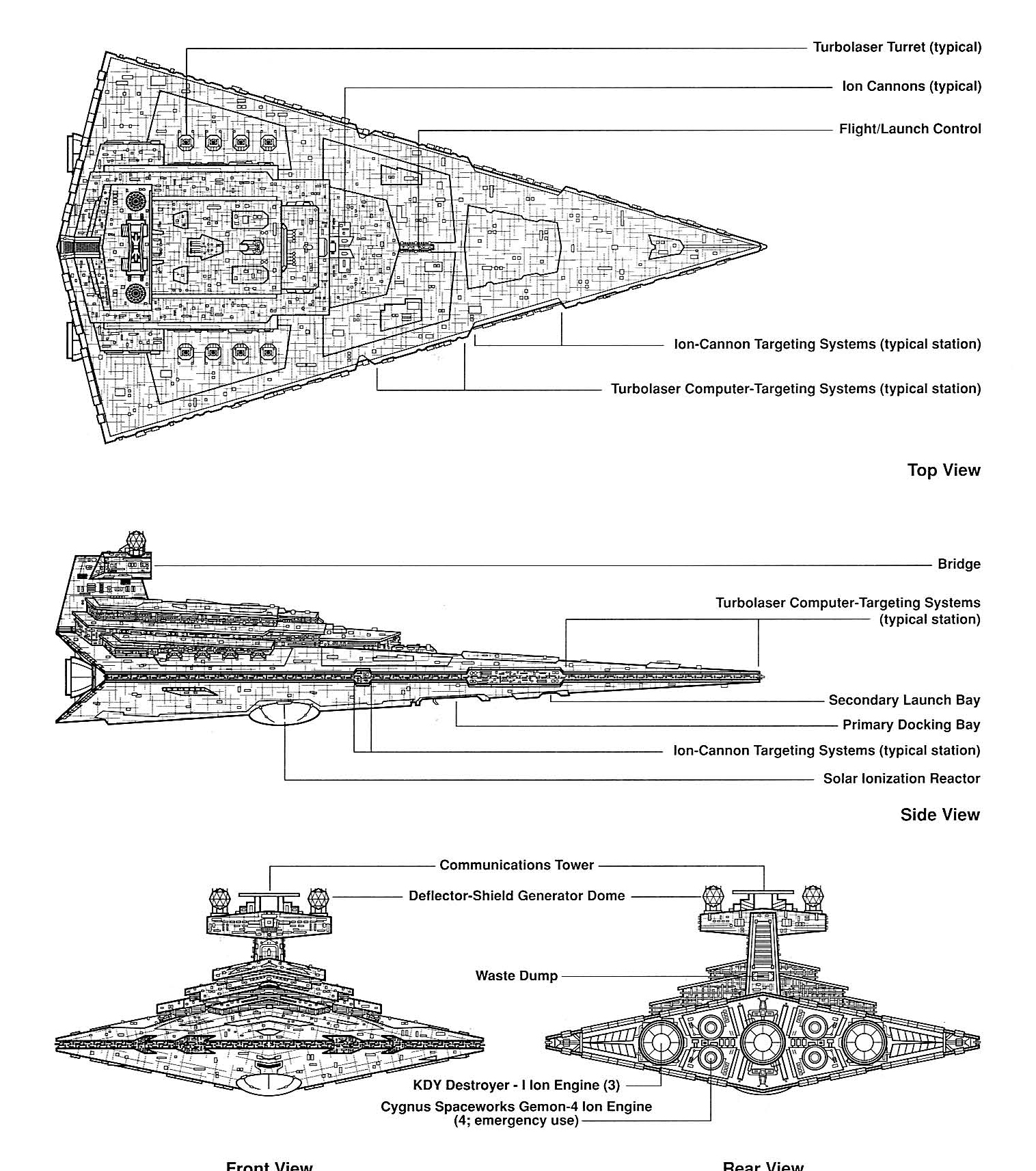
Okay, so that’s basic fields of fire as influenced by technology. Okay, ready? THIS is an Imperial Star Destroyer:

Related image

Take a good look at the turbolaser batteries. They are arranged in broadsides, and they are tiny compared to the ship, and most ridiculously, they are in turrets.

Now, the fact that they are tiny is not a problem. We know from Star Wars canon (no pun intended) that these are very powerful ships. It may be that Star Wars ships HAVE to be that much bigger than the weapons they carry simply to power them, and that most of that mass IS power generation.

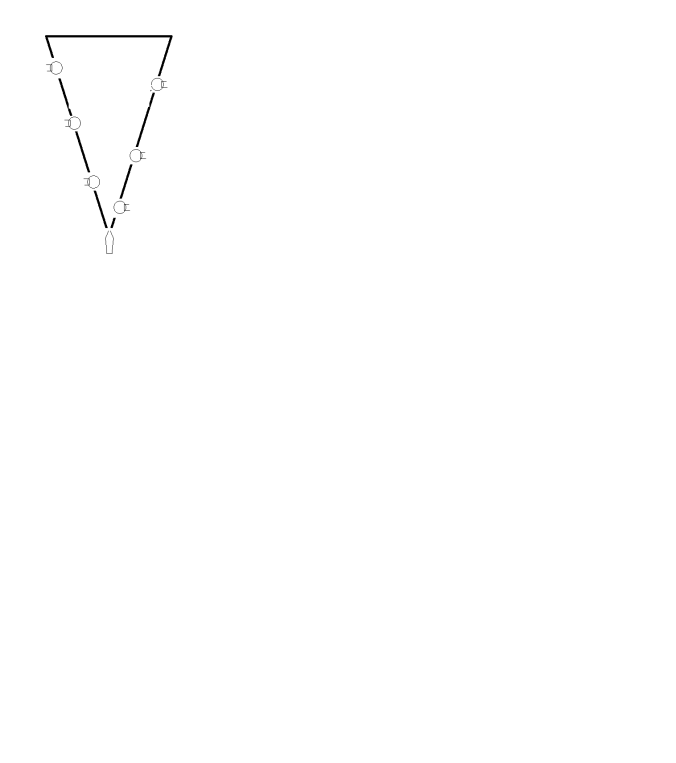
But they are arranged in broadsides, and only half of them can fire at a given moment because of the superstructure. Which begs the question: was there any reason these guns couldn’t have been put on the BOTTOM of the ship? They can’t even fire forward or aft except at half-strength, because the guns block each other. For a simplified version, they look like this (please forgive the ridiculously poor computer drawing skills):

ISD 1

Now in space, there’s no excuse for this., especially when we know that the Star Wars universe has the technology to make very fast and maneuverable turrets. The only way this makes sense at all is if a Star Destroyer can roll and pitch so fast that turrets don;t really matter at all, and we know from the events of pretty much all Star Wars movies that this is not the case.

A far superior design would be this:

ISD 2.png

From this design, we can immediately see that I don’t know how to manipulate images very well, but we can ALSO see (and this is my point) that with larger, globular turrets that could clear the entire hull, a Star Destroyer design could easily have been imagined that would have allowed all turrets to bear on targets both above and below and (assuming, again, large turrets and a FLAT hull), to fore and aft, and even to both sides simultaneously by offsetting them as pictured. The bridge (assuming it could not have been buried deep in the hull, which is where it always SHOULD have been) could be moved up front.

Why isn’t this done? Well, I suspect that for one thing, people tend to find asymmetry ugly, even when it is practical. And for another, Lucas seems to have really liked the idea of big ships with tiny guns, possibly to justify his overreliance on space fighters (about which more another time). But it just annoys me when people build ships that, for no apparent reason, have huge unnecessary blind spots. When we build the ships of the future, they should at least be well-built.


How Not To Worldbuild: Ep. I, The Phantom Mess.

So, I realize it’s a little late to bash on Star Wars, Ep. I, The Phantom Menace, but I have a good excuse; I have three children. So upon discovering that the prequels existed, which they did by the subtle and clever ability of knowing how to count things in a sequence, they asked me if I would please, please PLEASE check out the prequels from the library so they could watch it despite my wife’s and my strong moral position of not having such filth in our house.

These are the struggles facing those of us who dare to parent responsibly and with discipline.

But yes, I caved.

And I am proud that one of the first questions my son asked was pretty much: “So what’s a blockade, and how come the Trade Federation can just do that?”

Which of course, was one of the questions that Lucas should have asked himself before penning this godsawful mess. See, in the opening crawl, we are told that the whole mess with Naboo stemmed from the taxation of “outlying trade routes” being “in dispute.” Which led to the Trade Federation imposing a supposedly “perfectly legal” blockade of Naboo because…

Because why? Because it was Freak-Out Friday? We know that Naboo and the Trade Federation are both member states of this Galactic Republic. I mean, ignoring the fact that a blockade is pretty much always an act of war, and ignoring the fact that I can’t even THINK of a historical precedent for a polity that would legally allow one member state to straight-up blockade another member state, what possible advantage does this confer to the Trade Federation? Senator Palpatine later says that the “taxation” of the trade routes issue began in the Galactic Senate, but never says who was taxing what, or why, or how the Trade Federation blockading Naboo makes sense as a retaliatory measure.

As a side note, I think the only thing that makes remote sense is that somehow, Naboo refused to pay the taxes, and the Trade Federation retaliated with a blockade. And when Chancellor Velorum sent the Jedi to negotiate, Sidious ordered their deaths and the subsequent invasion of Naboo to prolong the crisis. Of course, this is pretty funny when you realize that the whole thing relies on the Senate being just fine with ignoring the invasion of Naboo, AND YET ready to remove the Chancellor for IGNORING the invasion of Naboo, AND THEN replacing him with the Senator from Naboo, who will not ignore the invasion of Naboo.

Now, I suppose one can always say that that’s a hell of a lot of backstory that’s not very interesting, but that ignores the fact that the original Star Wars painted a completely logical picture of the Imperial Government with just a few sentences in passing:

“Holding her is dangerous. If word leaks out, it could generate sympathy for the Rebellion in the Senate.”

“Send a distress signal. Then inform the Senate that all aboard were killed.”

And later…

“The Imperial Senate will no longer be of any concern to us. I’ve just received word that the Emperor has dissolved the council permanently. The last remnants of the Old Republic have been swept away.”

“That’s impossible! How will the Emperor maintain control without the bureaucracy?”

“The regional governors will now have direct control… fear will keep the local systems in line. Fear of this battle station.”

In five sentences, we have a complete and coherent picture: The Emperor is consolidating control over the relatively-new Galactic Empire, and using the equivalent of nuclear weapons to do it. He and Vader are keeping the inflammatory arrest of a Senator for treason quiet until the Emperor can dissolve the Senate, and the Death Star is ready to back the power play. All of this is reasonable, and it takes maybe three minutes of dialogue. That’s excellent worldbuilding.

Twenty years later, in its place, we have far more dialogue that gets us exactly nowhere. It’s like he just didn’t care.

Reverse Poison: Writing Advice

Chemical weapons are funny things. I remember doing research on them back in high school, and reading about what were called “medical countermeasures.” This meant, basically, that you would take someone who had been exposed to a nerve agent that, say, depressed neurotransmitters, and you would give them a shot of something that would overproduce them. Of course, you really had to be careful with this, because taking the antidote by itself would kill you just as surely as the chemical agent would. Essentially, you poisoned the body in the opposite way it had been poisoned, and that let you go on living. But the body had to have been poisoned that way in the first place.

Reading Anne Lamott’s Bird By Bird reminded me of this, especially when, late in the book, she gave the advice that when one is suffering writer’s block, one must “resign as the controller of one’s fate.”

Now, the problem with that advice is that by itself, it is exactly the kind of advice that I-As-A-Beginning-Writer did not need to hear. It sounds like, “Hey, don’t worry about being blocked. Go off and fill yourself with the universe and come back when you are Inspired And Ready To Write.” And by itself, that advice is the Death Of All Writing. Because that feeling is rare and far between, and the only way I have ever found of summoning it with any chance of success is to write when I do NOT feel it.

Now, taken in context with the rest of the book, it’s pretty clear that what Anne means is more along the lines of, “You can’t summon brilliant writing on demand, so you have to abandon that hope and resign yourself to writing what feels like shit for awhile, even if it’s only a little of it, until you push through and it feels good again.” In that context, the advice is extremely valuable, and leads to good results. The problem is that the quote is so., well, quotable that you run the risk of finding it in isolation — or worse, understanding it in isolation — and poisoning yourself by taking the antidote to a problem you haven’t been privileged to have yet.

Wait for the problem of being a disciplined writer first. Then the advice to resign control of the forward motion makes sense.