Science Fiction Pet Peeve: Really Bad Naval Architecture.

Okay, it’s time to discuss one of my favorite topics: Pet Peeves Of Science-Fiction. In this edition, we’ll discuss really awful naval architecture.
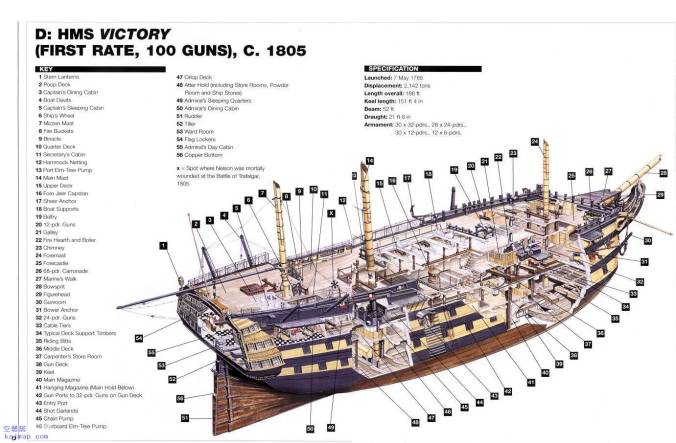
Naval architecture is, of course, the science and art of designing warships. Now, for most of history, warships were really just floating fighting platforms that rammed into each other, after which the soldiers aboard tried to kill one another in various awful ways. With the advent of guns, people had to decide where to put them, and the physics of sailing pretty much meant that the guns, which were very small compared to the ship, had to be placed in broadsides, like so:
Related image

However, with the advent of better steel and larger guns, cannon could be built that were a significant fraction of the ship’s width, and launch shells that would gain a lot from being able to elevate the guns significantly. Additionally, these guns were too heavy to permit the ship to carry twice as many of them that would be permanently pointed away from the ship. With the simultaneous elimination of sail, that meant that guns could and should be placed in turrets with about 270 degrees of action, thus:

Image result for uss new jersey deck plans

Of course, 360 degrees of action would have been better, but you have to have a place for the bridge, the smokestacks, and of course, the OTHER GUNS to be, safely.

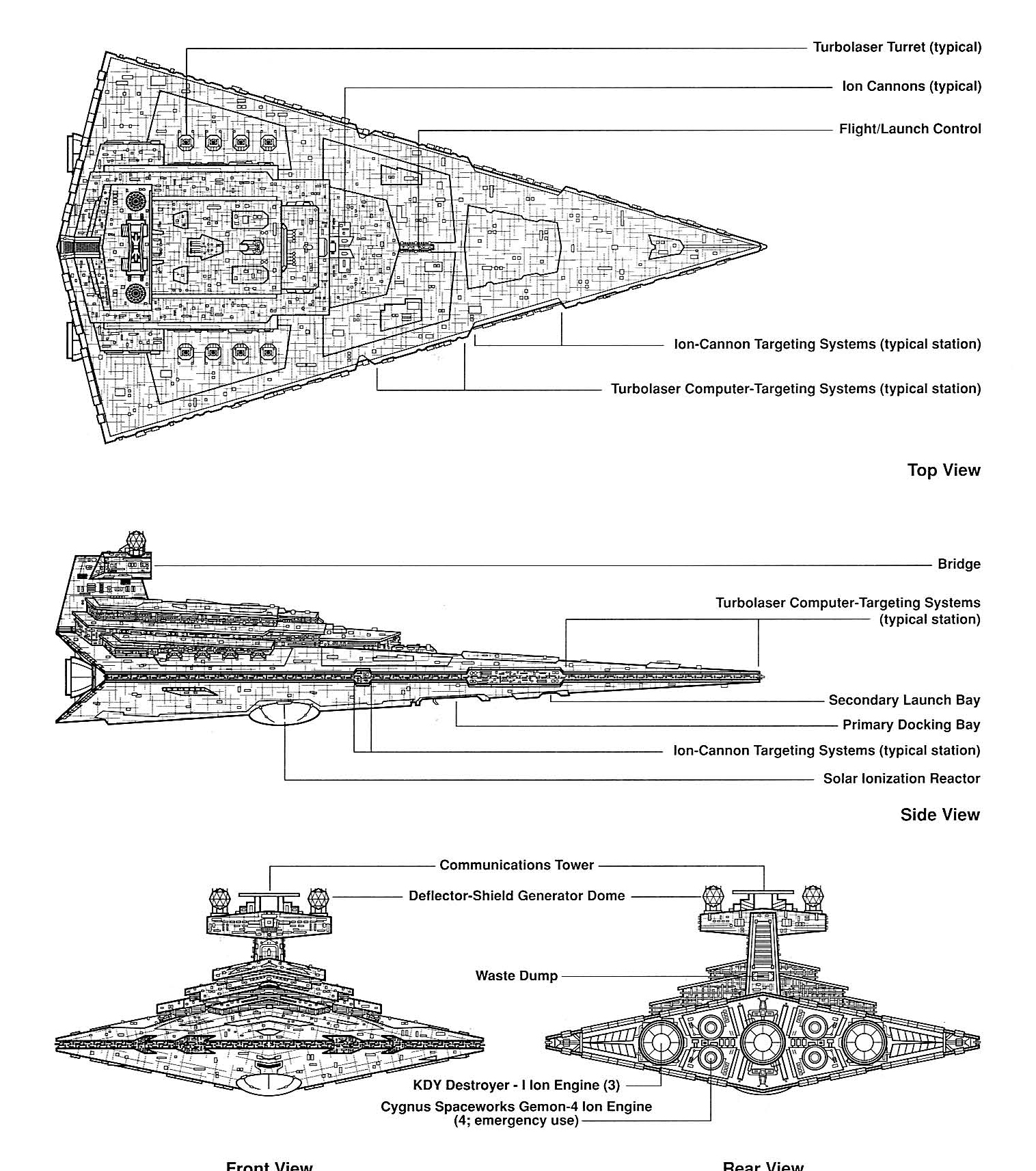
Okay, so that’s basic fields of fire as influenced by technology. Okay, ready? THIS is an Imperial Star Destroyer:
Related image

Take a good look at the turbolaser batteries. They are arranged in broadsides, and they are tiny compared to the ship, and most ridiculously, they are in turrets.

Now, the fact that they are tiny is not a problem. We know from Star Wars canon (no pun intended) that these are very powerful ships. It may be that Star Wars ships HAVE to be that much bigger than the weapons they carry simply to power them, and that most of that mass IS power generation.

But they are arranged in broadsides, and only half of them can fire at a given moment because of the superstructure. Which begs the question: was there any reason these guns couldn’t have been put on the BOTTOM of the ship? They can’t even fire forward or aft except at half-strength, because the guns block each other. For a simplified version, they look like this (please forgive the ridiculously poor computer drawing skills):

ISD 1

Now in space, there’s no excuse for this., especially when we know that the Star Wars universe has the technology to make very fast and maneuverable turrets. The only way this makes sense at all is if a Star Destroyer can roll and pitch so fast that turrets don;t really matter at all, and we know from the events of pretty much all Star Wars movies that this is not the case.

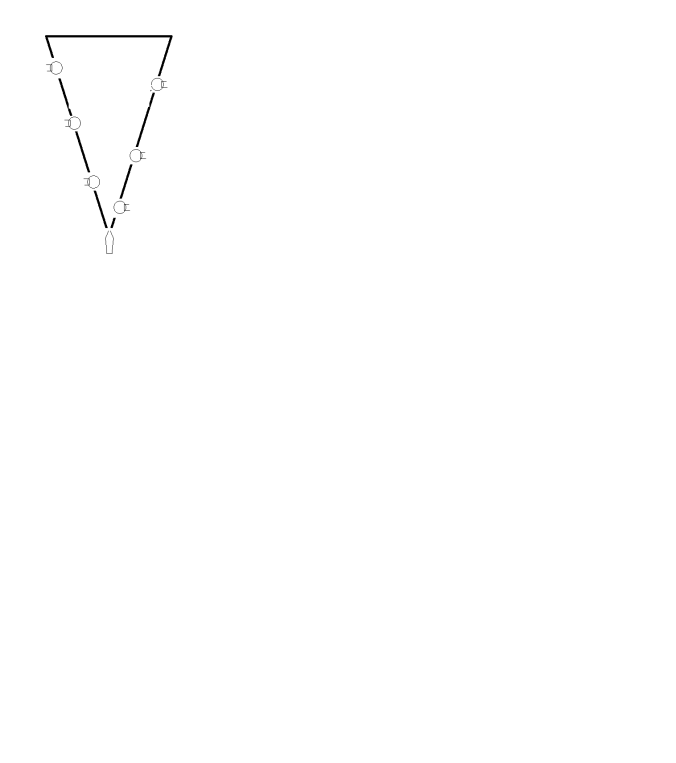
A far superior design would be this:
ISD 2.png

From this design, we can immediately see that I don’t know how to manipulate images very well, but we can ALSO see (and this is my point) that with larger, globular turrets that could clear the entire hull, a Star Destroyer design could easily have been imagined that would have allowed all turrets to bear on targets both above and below and (assuming, again, large turrets and a FLAT hull), to fore and aft, and even to both sides simultaneously by offsetting them as pictured. The bridge (assuming it could not have been buried deep in the hull, which is where it always SHOULD have been) could be moved up front.

Why isn’t this done? Well, I suspect that for one thing, people tend to find asymmetry ugly, even when it is practical. And for another, Lucas seems to have really liked the idea of big ships with tiny guns, possibly to justify his overreliance on space fighters (about which more another time). But it just annoys me when people build ships that, for no apparent reason, have huge unnecessary blind spots. When we build the ships of the future, they should at least be well-built.
 

Travel, DragonCon, and Why Has The Blog Been So Sparse Lately?

So, this is just a brief note to catch everyone up.

This is a busy time of year for me: the kids are all starting a new school year at a new school, I’m starting teaching new courses at a new school, and for the past three days, I’ve been at a camp related to the new school, where internet connectivity was spotty at best.

This is why there has been no blog this week, and only weekly updates for the past week or so.

In addition, on Thursday evening, I’ll be traveling to DragonCon. Unfortunately, I’ll be going as a fan rather than as a professional, because I didn’t know I’d be going until the last minute. But I’m looking forward to seeing a lot of fellow writers there. And, who knows, I might even run into a fan or two!


How Not To Worldbuild: Ep. I, The Phantom Mess.

So, I realize it’s a little late to bash on Star Wars, Ep. I, The Phantom Menace, but I have a good excuse; I have three children. So upon discovering that the prequels existed, which they did by the subtle and clever ability of knowing how to count things in a sequence, they asked me if I would please, please PLEASE check out the prequels from the library so they could watch it despite my wife’s and my strong moral position of not having such filth in our house.

These are the struggles facing those of us who dare to parent responsibly and with discipline.

But yes, I caved.

And I am proud that one of the first questions my son asked was pretty much: “So what’s a blockade, and how come the Trade Federation can just do that?”

Which of course, was one of the questions that Lucas should have asked himself before penning this godsawful mess. See, in the opening crawl, we are told that the whole mess with Naboo stemmed from the taxation of “outlying trade routes” being “in dispute.” Which led to the Trade Federation imposing a supposedly “perfectly legal” blockade of Naboo because…

Because why? Because it was Freak-Out Friday? We know that Naboo and the Trade Federation are both member states of this Galactic Republic. I mean, ignoring the fact that a blockade is pretty much always an act of war, and ignoring the fact that I can’t even THINK of a historical precedent for a polity that would legally allow one member state to straight-up blockade another member state, what possible advantage does this confer to the Trade Federation? Senator Palpatine later says that the “taxation” of the trade routes issue began in the Galactic Senate, but never says who was taxing what, or why, or how the Trade Federation blockading Naboo makes sense as a retaliatory measure.

As a side note, I think the only thing that makes remote sense is that somehow, Naboo refused to pay the taxes, and the Trade Federation retaliated with a blockade. And when Chancellor Velorum sent the Jedi to negotiate, Sidious ordered their deaths and the subsequent invasion of Naboo to prolong the crisis. Of course, this is pretty funny when you realize that the whole thing relies on the Senate being just fine with ignoring the invasion of Naboo, AND YET ready to remove the Chancellor for IGNORING the invasion of Naboo, AND THEN replacing him with the Senator from Naboo, who will not ignore the invasion of Naboo.

Now, I suppose one can always say that that’s a hell of a lot of backstory that’s not very interesting, but that ignores the fact that the original Star Wars painted a completely logical picture of the Imperial Government with just a few sentences in passing:

“Holding her is dangerous. If word leaks out, it could generate sympathy for the Rebellion in the Senate.”

“Send a distress signal. Then inform the Senate that all aboard were killed.”

And later…

“The Imperial Senate will no longer be of any concern to us. I’ve just received word that the Emperor has dissolved the council permanently. The last remnants of the Old Republic have been swept away.”

“That’s impossible! How will the Emperor maintain control without the bureaucracy?”

“The regional governors will now have direct control… fear will keep the local systems in line. Fear of this battle station.”

In five sentences, we have a complete and coherent picture: The Emperor is consolidating control over the relatively-new Galactic Empire, and using the equivalent of nuclear weapons to do it. He and Vader are keeping the inflammatory arrest of a Senator for treason quiet until the Emperor can dissolve the Senate, and the Death Star is ready to back the power play. All of this is reasonable, and it takes maybe three minutes of dialogue. That’s excellent worldbuilding.

Twenty years later, in its place, we have far more dialogue that gets us exactly nowhere. It’s like he just didn’t care.

Where Stories Come From: When The Fleet Comes

I think it’s safe to say that the most popular story I’ve written is “When The Fleet Comes” (which you can buy at the link to the right for only $1.00). It was for months the best-selling short story for Digital Fiction Corporation, and for all I know, still is.

“Where do you get your ideas” is a classic question to writers that has become a cliche, and most of us respond with something like “where don’t you get ideas,” because seriously, they’re everywhere. Contrary to many assumptions, writers never run out of ideas. They just run out of ways to execute them properly, which is a lot harder. But this one, I remember.

So many of my ideas for writing stories seem to come from me being tired of reading the same old plots again. The core of the story — that the Earth is destroyed — is a very old one, going back arguably to religious prophecy. But those stories always seem to end in one of two ways: humanity escapes to a new world and/or achieves revenge on its destroyers, and starting anew as masters of their own fates (When Worlds Collide, Titan, A.E.) or it’s entirely a memento mori tale (On The Beach, I Am Legend).

And yet history is replete with the stories of people whose tribes were almost wiped out, leaving them with no home to go to, no new frontier within their reach. The Native Americans, the Tibetans, the South Vietnamese, and too many others to count were left with the choice to live under an alien dictatorship, or to flee into exile and live with aliens. And they had to go on, and build new lives in cultures that would never be theirs, and preserve parts of themselves to pass on to their children, knowing that it would never be more than parts.

There was no one moment that inspired me to write the story. I just wondered how people from my own heritage might deal with the loss of their entire social and cultural framework. And so I considered Sean, the orphan adopted into alien culture, never really considering “his” people to be his. And I considered Amanda and her father, George, trying to, in their own way, continue the human race on an alien world, and finding their own, flawed answers to the question, what is important? What do we remember? What do we do to survive? What makes us… us? They do it by turning inward, but also by accepting a grim necessity. And I also considered Sean’s alien wife, Ajna, and her well-meaning naivete that hurts him, but nevertheless holds a degree of insight into his pain.

In any case, it seems to have spoken to more people than anything else I’ve ever written, and I think this is one of the things I really value in the SF I choose to read: the challenging of the dichotomies that are so often presented. The cry, “Victory or Death” echoes down through the ages and is a popular theme, but what happens when the first is out of your reach and the second seems unthinkable? If you are one of those who read the story and enjoyed it, I can only say, thank you for showing me that I am not alone in considering these things.

Reverse Poison: Writing Advice

Chemical weapons are funny things. I remember doing research on them back in high school, and reading about what were called “medical countermeasures.” This meant, basically, that you would take someone who had been exposed to a nerve agent that, say, depressed neurotransmitters, and you would give them a shot of something that would overproduce them. Of course, you really had to be careful with this, because taking the antidote by itself would kill you just as surely as the chemical agent would. Essentially, you poisoned the body in the opposite way it had been poisoned, and that let you go on living. But the body had to have been poisoned that way in the first place.

Reading Anne Lamott’s Bird By Bird reminded me of this, especially when, late in the book, she gave the advice that when one is suffering writer’s block, one must “resign as the controller of one’s fate.”

Now, the problem with that advice is that by itself, it is exactly the kind of advice that I-As-A-Beginning-Writer did not need to hear. It sounds like, “Hey, don’t worry about being blocked. Go off and fill yourself with the universe and come back when you are Inspired And Ready To Write.” And by itself, that advice is the Death Of All Writing. Because that feeling is rare and far between, and the only way I have ever found of summoning it with any chance of success is to write when I do NOT feel it.

Now, taken in context with the rest of the book, it’s pretty clear that what Anne means is more along the lines of, “You can’t summon brilliant writing on demand, so you have to abandon that hope and resign yourself to writing what feels like shit for awhile, even if it’s only a little of it, until you push through and it feels good again.” In that context, the advice is extremely valuable, and leads to good results. The problem is that the quote is so., well, quotable that you run the risk of finding it in isolation — or worse, understanding it in isolation — and poisoning yourself by taking the antidote to a problem you haven’t been privileged to have yet.

Wait for the problem of being a disciplined writer first. Then the advice to resign control of the forward motion makes sense.

Science-Fiction Dont’s: A Micropost

Hi, readers!

I’m a little behind, so I have to leave you with this observation:

One of the worst things a science-fiction writer can do is to introduce an amazing technology or alien ability, and then do nothing with it.

I was reminded of this when watching Attack of the Clones with my kids. Zam Wessel is chased down by Obi-Wan and Anakin, and under stress begins to revert to her true shape. Anakin recognizes that she is a Changeling.

And then, she utterly fails to change her face, attempting to sneak up on Obi-Wan disguised as the same attractive woman she was when they started chasing her. The whole thing goes nowhere, and we’re left with a terrible sense of disappointment. Never do that to your readers. It’s like going to a banquet and finding out that the delicious dessert in the center of the table is a frosted cardboard prop.

So, the reason I’m behind is that I’ve spent the last month (and a VERY intense last WEEK) revising a 620-page novel and have just sent it to a publisher. I’m done writing today.

How I Learned You Do Need An Editor

Okay, so I realize that many smarter people than I already figured this out. This post is for people, like me, who are better-than-average at spelling, sentence construction and mechanics. People who, like me, are often told that they write very clean copy. People who, like me, have sometimes wondered why they would need an editor before self-publishing. Upon re-reading my novel that I have fully revised TWICE and was now revising for the third time, AND which has been through easily a half-dozen beta readers, I discovered, among other things:

That most of the regiments and noble houses had at least two different color schemes for their banners and uniforms.

My main villain’s formal regalia was elaborately and stunningly described, with some of the best prose I have ever written… three separate and completely different ways.

During the climax, A military unit ambushed and murdered another military unit that it had relieved over a week previously.

The succession of the kingdom was arranged such that my villain could and should have solved the problem with a cup of poisoned wine and an unfortunate accident about ten years ago.

My protagonist’s nasty younger brother reacted to something before he ever showed up.

My protagonist’s personal rifle had a plot-activated bayonet.

Now, I’ve never used a professional editor, but I had read this thing a half-dozen times, had beta readers do the same, and while they pointed out a number of problems, these skated right by them. So I know the results of NOT using one. And they are to be avoided.

Edited To Add: I would like to say (because I meant to, but not strongly enough) that I do not mean any of the above to cast aspersions on my wonderful beta readers. Firstly, there was a lot MORE wrong with the novel when they saw it, and they caught a BUNCH of errors and weak points. Secondly, it’s not really their job to catch everything. That’s why you HAVE an editor.


The “Importance” Of Originality In One Easy Lesson.

I just sold a story about Space Marine Midwives with Disabilities to a pro market magazine (announcement of which one when contract is signed).

This should teach us two things about “originality.”

  1. No idea is so completely bizarre that it should be cast aside as unworthy  of being published.
  2. Since the GENESIS of this story was actually a Call For Submissions (for an anthology that as far as I know, never even opened to submissions. Yeah, um, really should have gone on to that if you wanted this story, guys) that SPECIFIED “Space Marine Midwives,” there is no idea so completely bizarre AND original that no one has thought of it already.

In other words, “Originality” doesn’t matter a DAMN as long as it’s good writing and doesn’t FEEL like a retread.

The rest is up to you.

A Few MORE thoughts on Worldbuilding with Food, and Art

So, a few weeks ago, I posted some Thoughts on Worldbuilding. And in the natural course of things, another blogger linked to it here.

Now, while it’s always flattering to have people link to your blog, because it means that they found what you had to say worthwhile (or at least, worth screaming about), I fear that my colleague of teh Interwebz misunderstood the technique I was trying to highlight. Because he (or she) had this to say:

“Food is the easiest but only becomes a concern when the characters don’t have a steady reliable supply of it. Or if they are moving between multiple cultures. Art and music are best left for the slower parts of the story and again would only be noticed if the character is operating outside his usual culture.”

And the problem is that this is both right and wrong at the same time. It lacks imagination, and it lacks an understanding of the role of the storyteller.

Now, it’s correct to say that noticing food, art and music are best done in the “slower” parts of the story, but that in itself reveals a limited understanding of pacing. Certainly, you don’t want characters thinking of food, art and music during a gun battle or a chase. But a fast pace, or rising tension, do not have to encompass anything that is literally fast or athletically active. Consider, for example, the dinner-party scene in Frank Herbert’s Dune. The tension rises inexorably as the various factions present do verbal battle for supremacy, and through it all, the food lays out a vibrant background that illuminates the cultures of Arrakis and the Imperium. It has nothing to do with a lack of supply, and little to do with multiple cultures.

But there are always multiple cultures in the act of telling a story. At least, there are two: the real culture of the real reader, and the artificial culture of the work. And even in a contemporary novel of America, food and art and music can be used to signal what things are important to the characters. Is this a man who turns up his nose at scotch improperly oaked? Or a man who enjoys ketchup sandwiches? Does she listen to Rob Zombie, or Pink Floyd?  Or Vivaldi. Does he notice the Warhol print in Wal-mart and spend money on it? Or is he going to snort at that and smugly congratulate himself on his understanding of Pollock?

Now, in F/SF, you have a whole culture to map out. It’s a challenge when your characters are intimately familiar with that culture, and they’re certainly not going to say things like, “Welcome to our home, Bob and Linda! Do sit down and partake of these lovely snarf-burgers, the principal Arcturan delicacy!” But look at what S.M. Stirling does in his excellent book, the Peshawar Lancers. He has to set up an alternate 21st century in which the United States was destroyed, and most of Europe crippled, by a cometary impact. It’s over a century later, and the British Raj is the dominant power. How does he portray this in the opening scenes of the novel?

Well, for one, he has his principal heroine sit down in the lavishly appointed dining room of an airship. She notices all the dishes (because of course we notice what we are eating, whether we are in a different culture or not) and her mind wanders to the huge reproduction of a famous mural that dominates the dining room, portraying the Exodus from England as the government of Great Britain removes itself from the Thames, sailing to Delhi. She then thinks how monstrously inappropriate a scene that includes cannibalism is for a dining room and of the Kipling Cantos that inspired the artist to paint such a thing. And so, in a couple of pages, we are treated to a snapshot of the culture of the 21st-Century Raj combined with a good deal of backstory which the heroine has good reason to be thinking of. It flows with a brilliant ease and never feels artificial, and it all comes from a lady sitting down and dining alone inside her own culture.